Welcome to Vbond
Why ACP is Evolving: The Future of Fire-Safe Aluminum Composite Panels
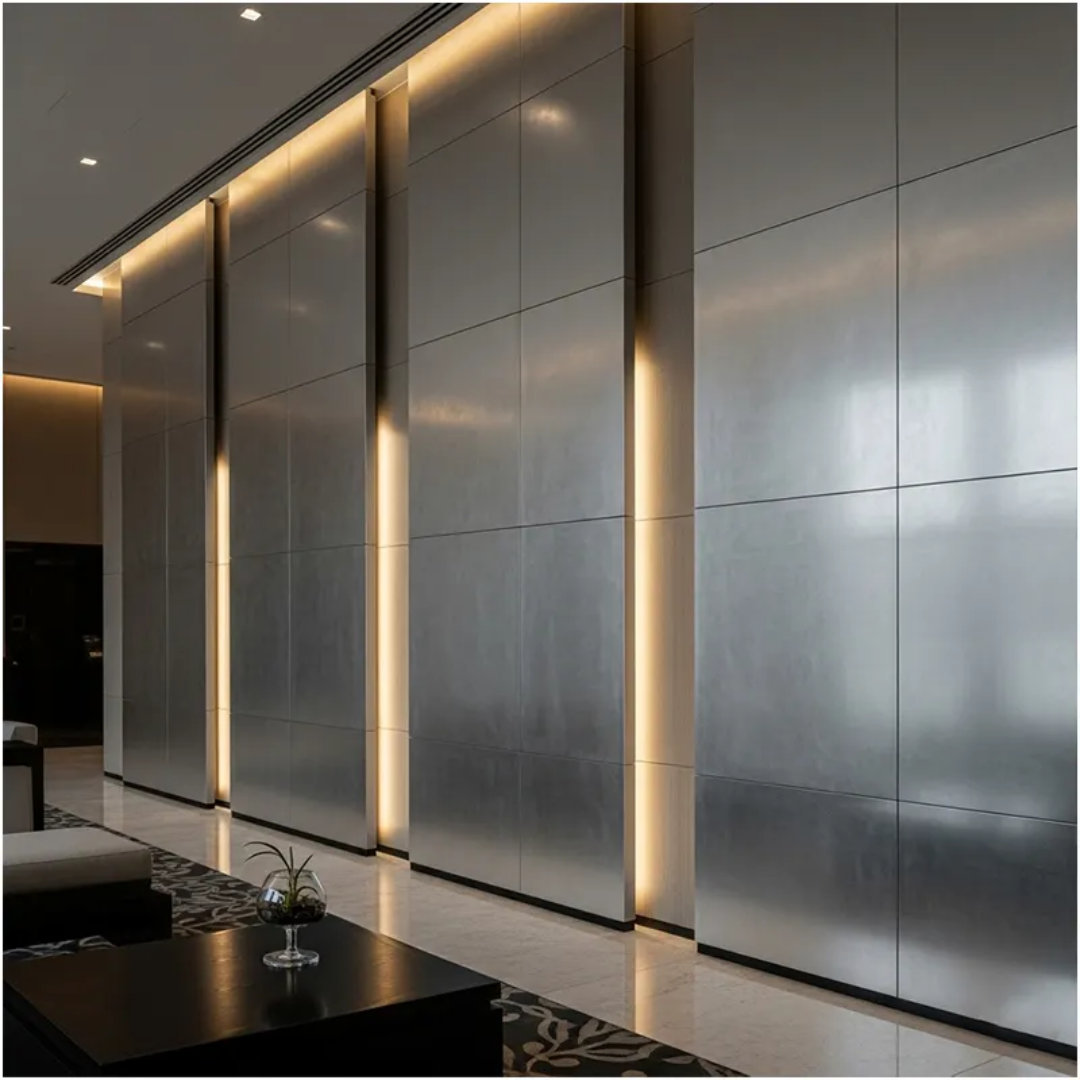
The aluminum composite panel (ACP) market is undergoing its most profound transformation since the material’s introduction. What began as a lightweight, cost-effective cladding solution has evolved into a sophisticated building material where fire safety now rivals aesthetics and durability as the primary specification criterion.
The global ACP market grew from $10.00 billion in 2025 to $10.78 billion in 2026, with a projected CAGR of 8.42% reaching $17.63 billion by 2032. However, these numbers tell only part of the story. Beneath the top-line growth lies a seismic shift in material composition, regulatory frameworks, testing protocols, and end-of-life considerations—all driven by an intensified global focus on building fire safety.
This article examines the forces reshaping fire-safe aluminum composite panels, from core material innovation to circular economy imperatives, and provides procurement professionals with the insights needed to navigate this evolving landscape.
Part One: The Regulatory Catalyst – From Tragedy to Transformation
The evolution of fire-safe ACPs cannot be understood without acknowledging the regulatory transformation triggered by high-profile fire incidents, particularly the 2017 Grenfell Tower tragedy. The combustible aluminum composite cladding used on Grenfell accelerated fire spread, resulting in 72 fatalities and a fundamental reassessment of building safety worldwide.
This catalyst has produced a cascade of regulatory changes:
United Kingdom: The Building Safety Act (BSA) enforces compliance with Regulation 7(2), banning combustible materials in external walls of certain high-rise buildings. Materials must achieve Class A2 or A1 per BS EN 13501-1. The government has set a 2029 deadline for the remediation of all high-rise buildings above 11 meters with unsafe cladding. In March 2026, a public consultation was launched on proposed updates to Approved Document B, covering revised guidance on fire spread across external walls, balconies, and roofs.
Europe: The revised European cladding fire test standard took effect on January 31, 2026, creating a new compliance landscape for property surveyors, buyers, and building owners.
Global Impact: Countries, including the UAE and UK, now mandate A2-grade materials for tall structures. Fire-resistant panels represent the dominant sub-segment in the ACP market, increasingly preferred in construction due to strict safety regulations and growing awareness of building safety.
This regulatory tightening is structural and irreversible, creating sustained, non-discretionary demand for fire-rated panels that persists regardless of broader construction cycles.
Part Two: Core Technology – The Science of Non-Combustibility
The fundamental driver of ACP evolution is core material innovation. Traditional polyethylene (PE) cores, while cost-effective, exhibit poor fire performance with melting points around 120°C, which leads to rapid structural collapse and intense flaming droplets during fire incidents. PE cores undergo complete pyrolysis with intense heat release, burning readily and generating flaming droplets that spread fire between floors.
Fire-Retardant (FR) Cores
FR variants incorporate mineral additives such as aluminum trihydrate or magnesium hydroxide, increasing ignition temperature to approximately 300°C and reducing peak heat release rates by 65% compared to standard PE cores. FR cores achieve partial char formation that slows fire progression.
Mineral-Filled A2 Cores
The most advanced mineral-filled cores utilize ceramic matrices or calcium silicate compositions that demonstrate truly non-combustible behavior, withstanding temperatures exceeding 1,000°C for over two hours without structural failure. These cores do not melt or drip when exposed to fire, significantly reducing flame spread and toxic smoke emission. The organic mineral-filled core does not emit toxic fumes or environmentally hazardous substances when subjected to heat.
Independent testing under ISO 5659-2 reveals mineral cores maintain smoke opacity below 5% during fire exposure, compared to 90%+ opacity from burning PE cores. This smoke performance is critical for occupant evacuation—dense, toxic smoke is the leading cause of fire fatalities, and low-smoke emission directly translates to improved survival outcomes.
A2-s1,d0 Classification
A2-s1,d0 denotes limited combustibility, minimal smoke production (s1), and no flaming droplets or particles (d0). The S1 smoke rating indicates very low smoke production—a critical factor in life safety, as smoke disorientation and toxicity claim more lives than direct flame contact. The d0 designation confirms no flaming droplets, eliminating the risk of molten material spreading fire downward to lower floors. This combination of non-combustibility, minimal smoke, and no flaming droplets establishes the gold standard for fire-safe cladding.
Market Growth of Fire-Rated Panels
The Class A2 Fireproof Aluminum Composite Panel Market was valued at $1.62 billion in 2025 and is projected to reach $2.55 billion by 2032, growing at a CAGR of 6.74%. The broader Class B fireproof segment was valued at $6.96 billion in 2025 and is projected to reach $11.82 billion by 2032 at a CAGR of 7.84%. The Global A2 Fireproof Aluminium Composite Panel Market is projected to grow from $3.6 billion in 2025 to $6.8 billion by 2032 at a CAGR of 8.3%. These figures demonstrate that fire safety is not a niche premium segment—it is becoming the mainstream standard.
Part Three: Testing and Certification – The Verification Imperative
As regulatory requirements tighten, the demand for verified testing data has intensified. Third-party certification is no longer optional.
Key Testing Standards
Standard | Scope | Key Requirement |
BS 8414-1 | Full-scale facade fire testing (UK) | Simulates real-world facade fire with propane flames exceeding 4.5MW for up to 60 minutes |
NFPA 285 | Vertical flame spread in wall assemblies (US) | Flames must not extend beyond 10 feet from the test window opening | |
EN 13501-1 | European reaction-to-fire classification | Rates materials from A1 (non-combustible) to F (highly flammable); ACPs typically achieve B-s1,d0 or A2-s1,d0 |
ASTM E84 | Tunnel test for flame spread and smoke development (US) | Measures flame spread index and smoke developed index |
The 2025 edition of NFPA 285, released in December 2024, updates the standard fire test method for the evaluation of fire propagation characteristics of exterior wall assemblies containing combustible components. Recent updates to these standards have introduced more stringent requirements for core material homogeneity verification and mandatory third-party certification of test specimens to prevent fraudulent submissions that plagued earlier testing regimes.
Modern testing laboratories now integrate advanced instrumentation, including high-density thermocouple arrays (50+ measurement points per square meter), infrared thermal imaging cameras, and Fourier-transform infrared spectroscopy for toxic fume analysis.
The Documentation Imperative
For procurement professionals, verifying that suppliers provide complete, accredited test documentation is essential. This includes accredited lab certificates, specimen photos, and exact construction drawings of tested assemblies so fire engineers can confirm the proposed curtain wall meets the project’s fire-safety strategy.
Part Four: Beyond Fire – Sustainability and Circular Economy
The evolution of fire-safe ACPs is increasingly intertwined with sustainability imperatives. Recyclability is becoming as important as fire performance.
Aluminum: The Infinite Resource
Aluminum is 100% recyclable without loss of quality. Recycling aluminum uses 95% less energy and produces 95% fewer emissions compared to primary aluminum production. When an ACP reaches the end of its life, the aluminum can be recycled repeatedly.
Closed-Loop Recycling Initiatives
In January 2026, Multipanel UK launched a closed-loop recycling programme for Alupanel ACP, turning used panels and offcuts into new manufacturing materials. The aluminum is smelted locally and prepared for reuse, while the recycled LDPE core returns to become part of new Alupanel sheets. Moss’s first collection achieved a 75% closed-loop recycling rate, with over six tonnes of plastic and 4.3 tonnes of aluminum recycled.
STACBOND offers an ACP recycling service designed to offer a fast and specialized solution, taking care of the product until the end of its life cycle, transforming waste into new opportunities. Viva ACP panels are made from recyclable aluminum and non-toxic cores, ensuring end-of-life recovery without harming the environment, designed using materials that can be fully recycled to contribute to a closed-loop system.
EPD Certification
Environmental Product Declarations (EPDs) have emerged as essential verification tools. Products like ALPOLIC™ A2 are EPD certified and almost 100% recyclable, providing transparency on lifecycle environmental impact.
Part Five: Market Dynamics – Growth Drivers and Restraints
Key Drivers
Stringent Fire Safety Regulations: The primary driver is increasing enforcement of stringent fire safety regulations in the construction industry. Following high-profile fire incidents involving traditional flammable panels, governments worldwide—particularly in Europe, North America, and the Middle East—have revised building codes to mandate the use of non-combustible or limited-combustible materials for building facades.
Growth in High-Rise Construction: Rapid urbanization and ongoing construction booms in developing economies fuel demand for modern cladding materials. A2 fireproof ACPs offer safety and design flexibility for skyscrapers, shopping malls, hospitals, and airports.
Insurance and Financial Incentives: Insurance premiums for buildings are increasingly linked to fire safety ratings of materials used, providing a strong financial incentive to opt for A2 fireproof panels over cheaper, less safe alternatives.
Key Restraints
Higher Cost: The specialized, non-combustible mineral core and advanced manufacturing processes make A2 panels up to 50–100% more expensive than standard PE-core panels.
Supply Chain Complexities: Production of A2 panels relies on specific, high-purity mineral fillers and fire-retardant additives. Securing a consistent and cost-effective supply chain for these raw materials remains a challenge.
Part Six: Future Outlook – What Procurement Should Watch
1. Continued Regulatory Evolution
The UK’s Approved Document B consultation (open until June 17, 2026) will shape fire safety guidance for years. Scotland has announced a review considering a ban on the highest-risk cladding materials, including metal composite material panels.
2. Material Innovation
Leading manufacturers like 3A Composites and Alucoil are investing in R&D to improve cost-efficiency while maintaining fire performance. Core chemistry and coating systems continue to advance, enabling thinner, more durable finishes that resist chalking and maintain color over extended exposures.
3. Sustainability Integration
Sustainability expectations are altering product roadmaps. Clients and specifiers increasingly request transparent lifecycle information, recycled content statements, and pathways for circularity, prompting manufacturers to invest in recyclable cores and recyclable coating systems.
4. Digital Traceability
Blockchain and AI are optimizing panel recycling networks through material passports and real-time logistics optimization, enabling greater transparency and verification of sustainability claims.
5. Procurement Strategy Evolution
Buyers now favor suppliers that demonstrate traceability, multi-sourcing capabilities, and the capacity to provide just-in-time deliveries for complex façade projects. Companies integrating reproducible testing data, transparent supply chains, and robust technical support will capture the trust of specification professionals.
Part Seven: Procurement Recommendations
For procurement professionals navigating the shift toward fire-safe ACPs:
1. Specify A2-s1,d0 for high-rise and sensitive applications. This combination provides the highest level of fire safety: non-combustibility, minimal smoke emission, and no flaming droplets.
2. Require third-party test documentation. Demand accredited lab reports for the specific panel assembly, not generic certifications.
3. Verify core material composition. Confirm mineral-filled A2 core with documented non-combustibility testing.
4. Consider total cost of ownership. A2 panels have higher upfront cost but offer lower insurance premiums, reduced liability exposure, and regulatory certainty.
5. Plan for end-of-life recyclability. Specify suppliers with documented recycling programs or closed-loop capabilities.
6. Stay informed on regulatory changes. Monitor Approved Document B updates in the UK, NFPA 285 revisions in the US, and EN standard developments in Europe.
Conclusion
The aluminum composite panel is evolving from a cost-effective cladding solution into a sophisticated building material where fire safety is the primary specification criterion. Driven by regulatory transformation following the Grenfell tragedy, enabled by mineral-core technology that achieves true non-combustibility, and increasingly integrated with circular economy principles, fire-safe ACPs represent the future of building envelopes.
For procurement professionals, the message is clear: A2 fire-rated panels are no longer a premium specialty product—they are becoming the baseline standard for high-rise and high-risk applications. By understanding the regulatory drivers, core material technologies, testing requirements, and sustainability imperatives shaping this market, you can make informed decisions that protect both building occupants and long-term asset value.
The future of ACP is fire-safe, verifiable, and circular. The time to specify accordingly is now.