Welcome to Vbond
Why Curved Aluminum Composite Panel Installations Fail with Inferior Core Materials
Why Curved Aluminum Composite Panel Installations Fail with Inferior Core Materials
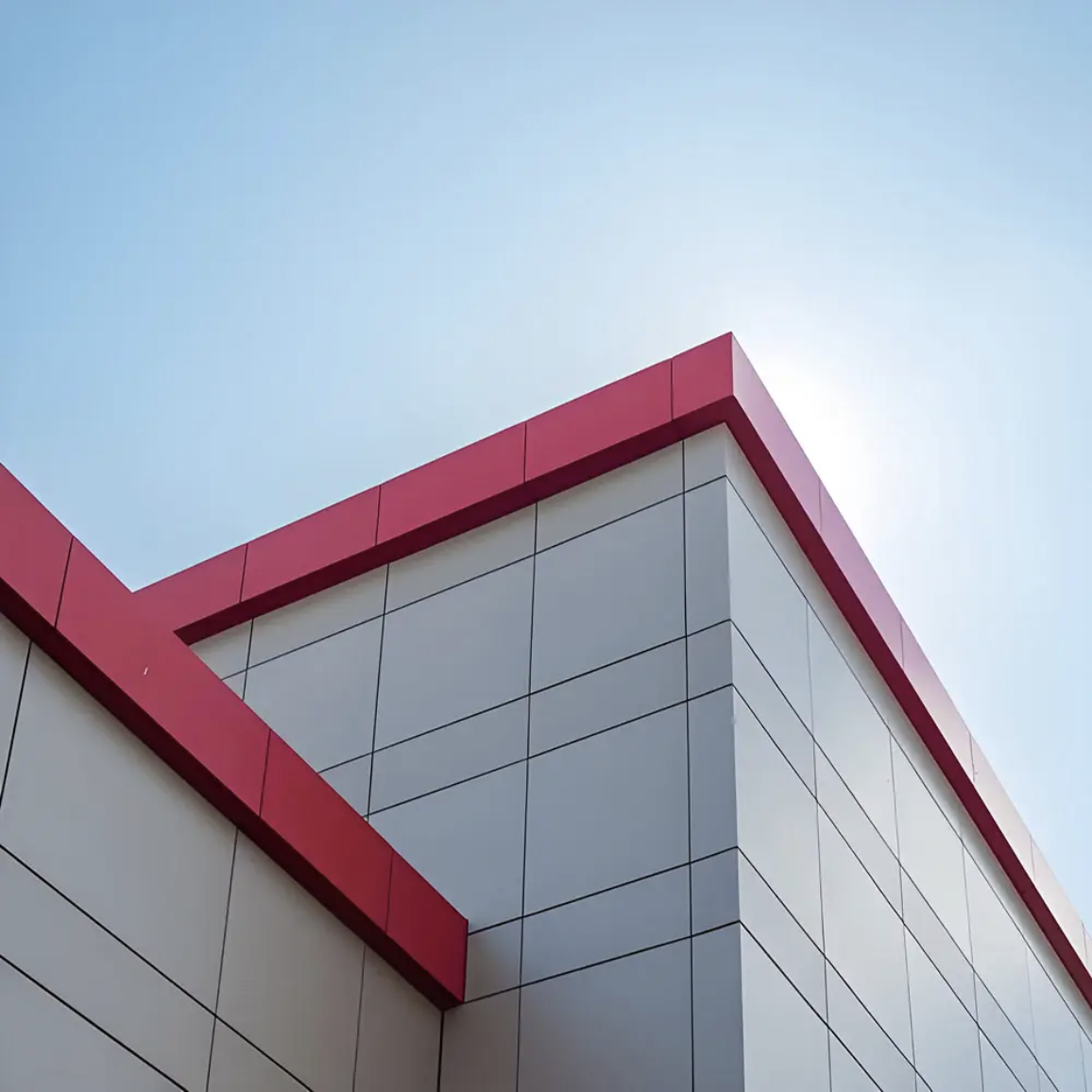
The sweeping curves of modern architecture—the soaring dome, the twisting façade, the flowing wave form—are often achieved using curved aluminum composite panels (ACPs). These installations represent the pinnacle of architectural ambition. But when inferior core materials are used, these ambitious curves can turn into expensive failures.
Cracking, wrinkling, delamination, and irreversible deformation are the hallmarks of a curved installation where the core material simply could not handle the stress. While a premium aluminum composite panel manufacturer like an Alucobond factory or ALUCOBOND manufacturer engineers its core for flexibility and resilience, low-grade panels with unstable cores lack the physical properties required for the complex bending process.
This guide explains how core materials behave under stress, why inferior cores lead to catastrophic failure, and how procurement professionals can ensure the success of their curved projects by demanding engineered materials from verified sources.
1. The Structural Science: Why the Core Matters in Bending
An aluminum composite panel is a sandwich structure: two thin aluminum skins bonded to a central core. When a panel is bent, the outer skin stretches while the inner skin compresses. The core must transfer these stresses between the skins while maintaining its own structural integrity.
The core is not just a filler; it is a structural component that must manage shear forces and prevent buckling. A high-quality aluminum composite panel manufacturer understands that for curved applications, the core must achieve several critical properties :
- High shear modulus – to transfer load between the face sheets without deforming.
- Sufficient compressive strength – to prevent crushing on the inner radius of the bend.
- Ductility – to follow the stretch of the outer aluminum skin without cracking.
- Thermal stability – to resist expansion or contraction that could warp the curve.
Research on composite curved panels explicitly identifies that core debonding (separation of the core from the aluminum skin) is a primary failure mode determining the peak load of a curved structure. When the bond between the core and the skin fails, the load transfer path is broken, and the panel instantly loses its structural integrity.
Furthermore, studies on composite wallboards indicate that the **fracture of the core material** under stress is a specific failure mode in curved or complex installations. This means the core itself breaks apart internally, turning a rigid panel into a loose, floppy shell. For inferior cores, this fracture occurs at stress levels far below what an engineered core can withstand.
2. Failure Mode 1: Cold Bending, Cracking, and Wrinkling
The most immediate failure during the bending process is cracking of the aluminum skin or wrinkling of the core material.
- Phenomenon: As the panel goes through the roller or press brake, the outer surface cracks (tension failure), or the inner radius crinkles like a squeezed soda can (compression failure).
- Inferior Core Connection: A low-density or brittle core fails to provide adequate support to the aluminum skins. Because the core compresses too easily, the skins are left to bear the full bending stress alone, exceeding their elastic limit.
- The Premium Solution: Professional Alucobond factory products use mineral-filled or high-density polyethylene cores that maintain their thickness and shape under load, distributing the stress evenly to the skins .
Industry guidelines specify strict minimum bend radii to prevent this. For example, a 4mm panel typically requires a bend radius (R) of ≥80mm to avoid stress fractures.
3. Failure Mode 2: Rebound Deformation (The "Spring-Back" Effect)
Sometimes the panel bends perfectly in the factory but "springs back" towards a flat shape after installation, creating a mismatch with the building's steel structure.
- Phenomenon: The arc surface flattens out, leaving a gap between the panel and the support keel, or causing the panel to bulge outwards.
- Inferior Core Connection: The core material has a poor "memory." If it lacks the required elastic modulus, it stores the energy of the bend rather than permanently deforming. When the pressure is released, it tries to return to its original flat state.
- Premium Solution: High-quality panels from an ALUCOBOND manufacturer have predictable, uniform mechanical properties. This allows engineers to calculate the exact "over-bending" required (e.g., 5-8% more curvature) to compensate for predictable rebound, resulting in a perfect final arc.
Without the data from a trusted aluminum composite panel manufacturer, the fabrication team is left guessing the spring-back factor, leading to geometry errors that are impossible to fix on-site.
4. Failure Mode 3: Delamination and Core Debonding
This is the hidden failure. The panel looks fine from the outside, but the bond between the aluminum skin and the core has failed.
- Phenomenon: Bubbles, ripples, or a hollow sound when tapping the curved panel.
- Inferior Core Connection: Cheap panels often use off-spec adhesives or insufficient surface treatment before lamination. When the panel is bent, the shear stress at the skin-core interface exceeds the weak adhesive strength, causing the layers to separate.
- Premium Advantage: In a certified facility, the lamination process is conducted under strict temperature and pressure controls. The peel strength (adhesion) is tested to ensure it can withstand the shear forces of a tight curve.
Once delamination occurs, the panel cannot be repaired. The structural integrity is gone, and the panel is at risk of falling or disintegrating under wind load.
5. Failure Mode 4: Thermal Buckling ("Oil Canning")
Curved facades are exposed to intense sun. Dark-colored curved panels can heat up significantly, causing the core to expand. If the core is unstable or if the installation restricts movement, the panel will buckle.
- Phenomenon: The smooth curve develops a wavy, distorted surface (the "oil drum effect").
- Inferior Core Connection: Standard PE (polyethylene) cores have a high coefficient of thermal expansion. When the temperature rises above 70°C, the core can expand by 1.5% or more. If the back of the panel lacks ventilation or the fasteners are too tight, the expanding core has nowhere to go, so it bulges outwards.
- Premium Solution: Premium A2 (mineral core) panels have a much lower coefficient of thermal expansion, making them inherently more stable under heat stress.
This is why high-rise buildings in hot climates increasingly mandate A2-rated mineral cores: they resist the expansion that causes thermal buckling.
6. Procurement Guide: Ensuring Curved Installation Success
To avoid these costly failures, procurement professionals must move beyond just ordering "curved panels" and instead specify the engineering required.
Checklist for Curved ACP Procurement:
1. Verify Minimum Bend Radius: Confirm the manufacturer’s data sheet specifies a minimum bend radius for the exact thickness and color being used (Darker colors absorb more heat and may require larger radii).
2. Demand Certification: Require documentation proving the core meets A2-s1,d0 (EN 13501-1) or specific FR standards, not just generic "fire retardant" claims.
3. Request a Mock-Up: For complex geometry or radii near the manufacturer’s limit, require a physical mock-up of the curve before full production begins.
4. Specify Core Density: For curves, avoid standard PE in high-heat zones. Specify a **mineral-filled or reinforced core known for dimensional stability.
5. Audit Adhesion: Request the latest peel test reports (batch-specific) from the aluminum composite panel manufacturer to confirm the lamination strength is rated for curved applications.
7. Conclusion
Curved aluminum composite panel installations fail when the core material lacks the structural integrity to manage the stresses of bending, heat, and load. Inferior cores lead to cracking during fabrication, spring-back deformation after installation, delamination of layers, and unsightly thermal buckling.
Procurement professionals who insist on materials from a verified Alucobond factory or ALUCOBOND manufacturer are not just paying for a name; they are paying for engineered material science—cores with predictable modulus, high shear strength, and thermal stability.
Specify the core as strictly as you specify the color. It is the core that holds the curve.