Welcome to Vbond
Why Some Aluminum Composite Panels Require Reinforced Substructures – And Others Don’t
Why Some Aluminum Composite Panels Require Reinforced Substructures – And Others Don’t
When specifying aluminum composite panels (ACPs) for a building facade, the substructure—the framework of metal rails, brackets, and stiffeners behind the visible cladding—is often an afterthought. Yet the complexity and cost of this hidden framework vary dramatically depending on the type of ACP selected.
Some panels require extensive, reinforced substructures with closely spaced supports and heavy-gauge framing. Others allow for wider spacing, lighter materials, and simpler installation. Understanding why these differences exist—and how to specify panels that minimize substructure demands—is essential for procurement professionals managing project budgets and timelines.
This guide explains the engineering principles behind substructure requirements, compares panel types, and demonstrates why a professional aluminum composite panel manufacturer, like an Alucobond factory or ALUCOBOND manufacturer, produces panels engineered for efficient installation.
1. The Engineering Principle: Why Substructure Exists
The substructure serves three critical functions:
Function | Function |
Load transfer | Transmits wind, seismic, and self-weight loads from the panel to the building structure |
Flatness provision | Provides a true, even plane for panel attachment, preventing oil canning and distortion |
Thermal accommodation | Allows for expansion and contraction of the facade without stress buildup |
The required substructure density is determined by the panel's flexural stiffness—its ability to resist bending under load. As defined in Chinese technical standards JGJ 255-2012, when metal panels are subjected to wind or seismic loads, the "middle ribs should have sufficient stiffness, and their deflection should not exceed 1/300 of the rib span". This standard exists because insufficiently stiff substructures allow panel deflection, leading to visible distortion, fastener stress, and potential system failure.
Panels with higher stiffness can span greater distances between supports, reducing substructure material and labor costs. The calculation of panel stiffness involves the panel's thickness, the elastic modulus of its materials, and the geometric properties of its core structure.
2. Panel Types and Their Substructure Demands
Solid Aluminum Panels
Solid aluminum panels (e.g., 3mm or 4mm thick) are monolithic—the entire thickness is aluminum alloy. While strong, they have the lowest stiffness-to-weight ratio among metal cladding options because they lack the geometric optimization of composite cores.
Property | Solid 3mm Aluminum | Typical Requirement |
Weight per m² | ~8.1 kg | Heavier than composites |
Relative stiffness | Baseline (lowest) | Requires closer support spacing |
Solid panels often require extensive ribbing. As JGJ 255-2012 specifies, "when necessary, stiffening ribs should be added to increase their stiffness and maintain the flatness of the board". The standard also mandates that "the thickness of the rib section should not be less than 1.5mm," adding significant material cost.
For solid aluminum, "edge folding should be done with mechanical grooving, and the depth of the groove should be strictly controlled; the bottom of the groove must not reach the face panel". This requirement adds fabrication complexity. Additionally, "for aluminum-plastic composite panels and aluminum honeycomb panels when folding edges, mechanical grooving should be used, and the groove depth should be strictly controlled, ensuring the bottom of the groove does not touch the face panel".
Standard Aluminum Composite Panels (PE Core)
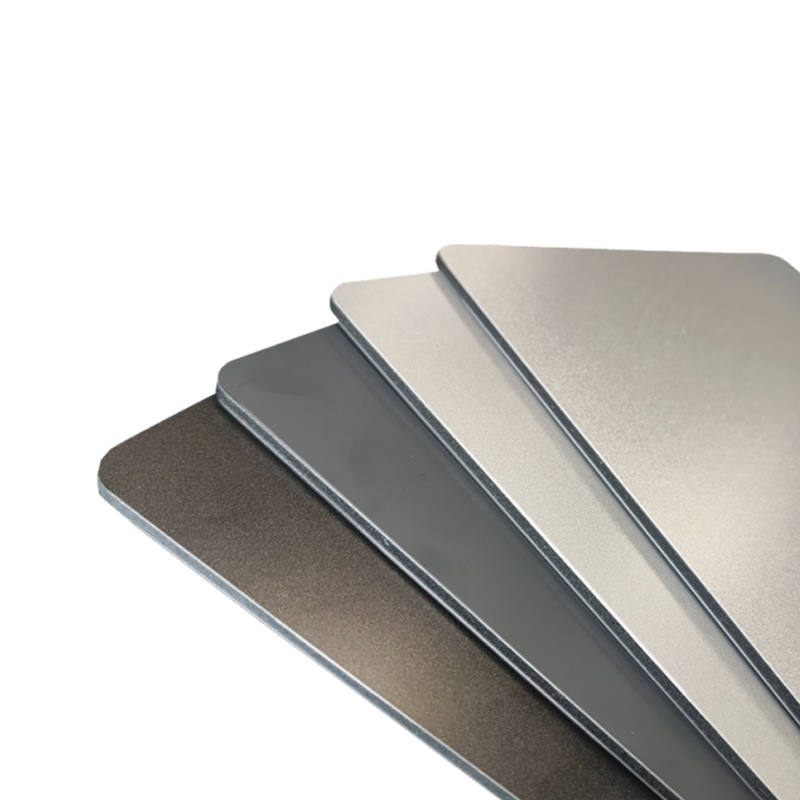
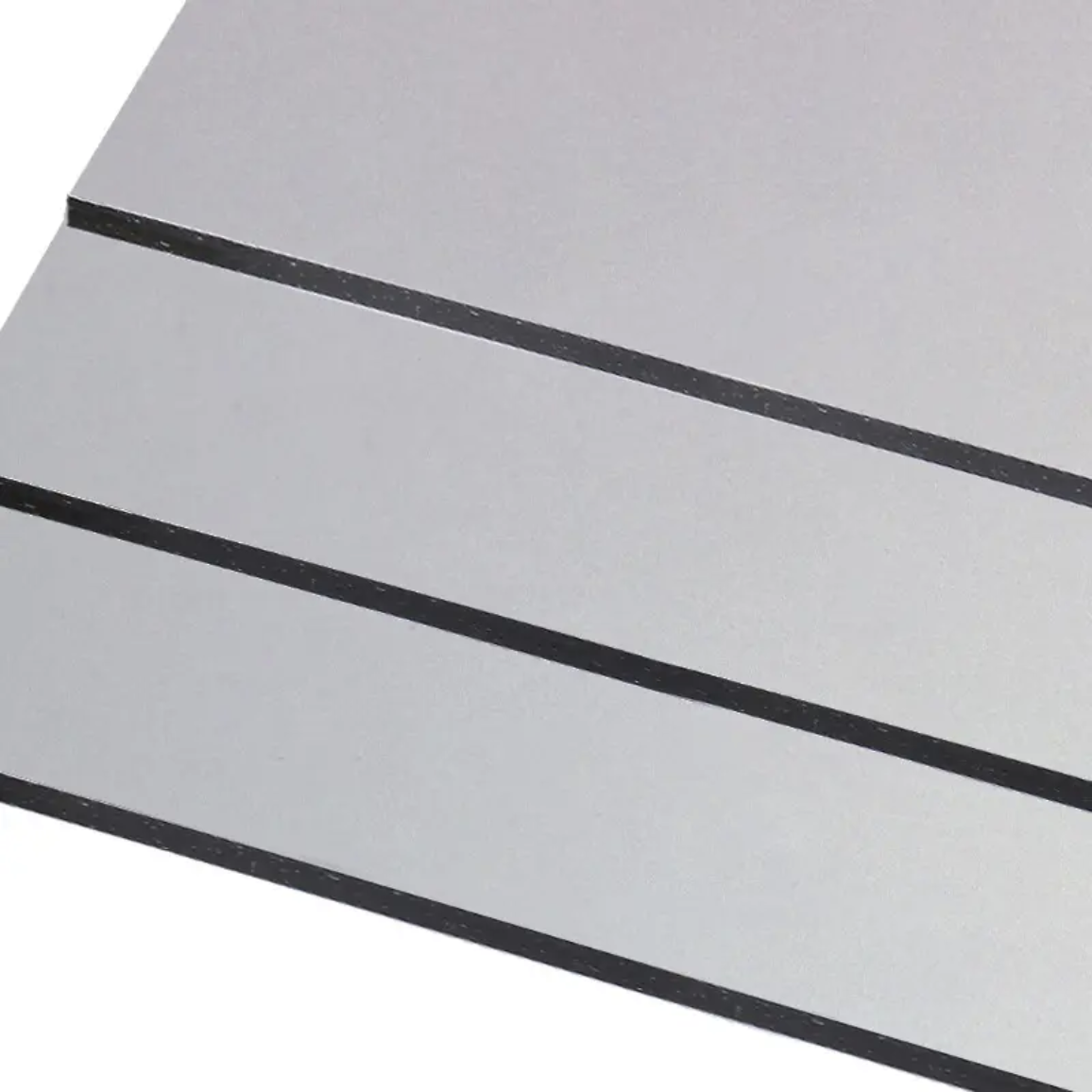
Standard ACPs consist of two thin aluminum skins (typically 0.3-0.5mm each) bonded to a polyethylene (PE) core. This sandwich structure provides significantly higher stiffness-to-weight ratios than solid aluminum because the core separates the skins, creating a strong "I-beam" effect.
Property | 4mm PE Core ACP | Advantage vs. Solid 3mm |
Weight per m² | ~4.8-5.5 kg | | ~40-50% lighter |
Stiffness-to-weight ratio | Higher | Allows wider support spacing |
Aalcopanel's standard interior-grade ACP, for example, uses "Aluminium Alloy 1100" skins with a "PE (Polyethylene) Thermoplastic core" and weighs "3.8kg per square metre" at 3mm thickness.
However, PE core panels have limitations. For exterior applications requiring fire resistance, the polymeric core may need additional support because it softens at high temperatures. The mineral-filled cores of fire-rated panels often provide superior structural performance.
Fire-Rated ACPs (FR and A2 Mineral Core)
Premium fire-rated panels from manufacturers like ALUCOBOND use mineral-filled cores with substantially higher density and stiffness than PE. The New Zealand CodeMark certification for ALPOLIC™ NC specifies a "4.0mm thick aluminium composite material (ACM) with a 3.0mm non-combustible mineral core, sandwiched between two skins of 0.5mm thick aluminium metal facings".
These mineral cores provide:
- Higher elastic modulus – Greater resistance to bending
- Improved thermal stability – Less deformation under temperature change
- Enhanced screw retention – Better fastener holding power
The superior stiffness of mineral-core panels allows for wider support spacing, directly reducing substructure costs.
Aluminum Honeycomb Panels
For the highest stiffness-to-weight ratio, aluminum honeycomb panels are unmatched. The core consists of a hexagonal cell structure, typically made from A3003 aluminum alloy. As research on aluminum honeycomb sandwich panels notes, these structures offer "excellent stiffness and strength criterion" and are "widely used for their excellent stiffness and strength criterion".
Property | 20mm Honeycomb Panel | 4mm ACP |
Flexural rigidity | 38.44 × 10⁶ N·mm² | Significantly lower |
Weight per m² | ~5.4-5.75 kg (20mm) | Similar range |
Support spacing | Much wider | Standard |
However, honeycomb panels come with trade-offs: higher material cost, more complex edge detailing, and specific fabrication requirements. "Aluminum honeycomb plates adopt aluminum alloy plates through perfluorocarbon spraying treatment as the face and plate. It is composed of a high-temperature and high-pressure structural plate, in the middle of which is an aluminum honeycomb core. It possesses the characteristics of light weight, high toughness, high stiffness, sound and heat insulation".
3. Why Some Panels Need Reinforcement
The "Rib" Requirement
Technical standards mandate that "for aluminum-plastic composite panels, edge ribs should be set at the folded edges". This means that even before considering the substructure, the panels themselves may require perimeter reinforcement.
The standard further specifies that "according to the stress requirements, stiffening ribs can be set. For aluminum-plastic composite panels, edge ribs should be set at the folded edges". These ribs:
- Prevent edge curl and distortion
- Distribute point loads from fasteners
- Maintain flatness across large spans
The "Floating Rib" Trap
A common substructure error involves "floating ribs"—stiffeners that are only attached to the panel face, not tied into the primary building structure. The technical standard warns that "in some projects, middle ribs are only considered to ensure the flatness of the panel, not as the supporting edge of the panel. At this time, the middle ribs are only connected to the panel, not connected to the edge ribs or folded edges of the single-layer aluminum panel. Both ends of the middle ribs are in a floating state without support and cannot serve as the supporting edge for the panel's grid. When calculating the panel, the supporting role of the middle ribs should not be considered".
Proper reinforcement requires ribs that are "securely connected to the panel and should have anti-corrosion measures. The middle ribs that serve as the supporting edge of the panel should be securely connected to the edge ribs or folded edges of the single-layer aluminum panel. The connection between the middle ribs supporting the metal panel grid and other intersecting middle ribs should meet the force transmission requirements".
4. The Connection between Core Design and Structural Performance
Research on sandwich panels consistently demonstrates that core geometry and material selection are the primary determinants of structural performance. A comparative study of different core materials (AL3105 aluminum, glass fiber, and Innegra fiber/epoxy composites) found that "the AL3105 lattice core has the highest strength-to-weight ratio".
This principle applies directly to ACPs. The core structure—whether solid PE, mineral-filled, or honeycomb—determines how loads transfer from the face sheets to the substructure. Panels with poorly engineered cores require more frequent supports because the load path is inefficient.
The technical standard JGJ 255-2012 codifies this, requiring that "for aluminum-plastic composite panels and aluminum honeycomb panels, when calculating, the thickness should be taken as the total thickness of the panel, and the strength should be adopted according to the standard". This acknowledges that the panel functions as an integrated composite, not as separate layers.
5. The Substructure Standard: What Codes Require
The Chinese "Metal and Stone Curtain Wall Engineering Technical Specification" (JGJ 133-2001) requires that "for metal sheets, along the surrounding edges, they should be fixed to the beams or columns with bolts. The bolt diameter should not be less than 4mm. The number of bolts should be determined by calculation based on the wind load and seismic action borne by the sheet". This applies regardless of panel type—the substructure must be engineered, not guessed.
For reinforcement, "the cross-sectional dimensions of the edge ribs of metal sheets should be designed according to structural requirements. Single-span middle ribs should be designed as simply supported beams. The middle ribs should have sufficient stiffness, and their deflection should not exceed 1/300 of the middle rib span".
The standard also specifies fastener requirements: "Metal sheets should be fixed to the beams or columns with bolts along the surrounding edges. The bolt diameter should not be less than 4mm. The number of bolts should be determined by calculation based on the wind load and seismic action borne by the sheet. Additionally, "when the edge ribs and middle ribs are connected to the metal sheet, they should be reliably connected and should have anti-corrosion measures".
6. The Alucobond Factory Advantage
When you source from a professional aluminum composite panel manufacturer like an Alucobond factory or ALUCOBOND manufacturer, you receive panels engineered for structural efficiency.
Mineral Core Technology
ALUCOBOND A2 features a "mineral (building material class A2, s1, d0)" core that provides "very high stability and flexural rigidity". This mineral fill constitutes over 90% of the core content, providing exceptional stiffness without adding significant weight.
Precise Flatness
The manufacturing process for premium ACPs involves "high-speed, automated, and intelligent production lines" that ensure consistent panel thickness and flatness. The ALUCOBOND® product line specifies "precise flatness" as a key attribute, which directly translates to predictable structural behavior under load.
Engineering Support
Premium manufacturers provide detailed engineering documentation, including:
- Allowable span charts for various wind loads
- Fastener spacing recommendations
- Thermal movement calculations
- Edge detailing requirements
This documentation enables precise substructure design—neither over-engineered (costly) nor under-engineered (dangerous). The ALPOLIC™ NC CodeMark certificate, for instance, specifies that the panel is "intended for use as part of an external cladding system" on buildings "within the scope of the NZBC acceptable solution E2/AS1 para 1.1, for wind zones up to and including 'Extra High'".
7. Procurement Implications
When specifying ACPs, consider how your choice affects substructure costs:
Panel Type | Core Material | Relative Stiffness | Substructure Density | Overall Cost |
PE Core ACP | Polyethylene | Low-Moderate | Standard | Low-Moderate |
FR Core ACP | Mineral-filled | Moderate | Standard-Moderate | Moderate |
A2 Mineral Core ACP | >90% Mineral | High | Reduced | Higher |
Honeycomb Panel | Aluminum cell | Very High | Minimized | High |
Questions for Your Supplier
1. "What is the panel's flexural rigidity (D) or equivalent bending stiffness?" – This allows direct comparison between products.
2. "What is the maximum recommended support spacing for our design wind load?" – A professional aluminum composite panel manufacturer will have span tables.
3. "Does the panel require edge ribs or perimeter reinforcement per JGJ 133?" – Clarifies fabrication requirements.
4. "Can we reduce substructure density with a thicker skin or mineral core?" – Determines if a premium panel upgrade pays for itself through substructure savings.
8. Conclusion
Some aluminum composite panels require reinforced substructures because their core materials lack the stiffness to span between supports without excessive deflection. Others—particularly those from premium manufacturers like Alucobond factory with mineral-filled cores or honeycomb construction—achieve sufficient rigidity to allow wider support spacing and lighter framing.
The choice affects not only material costs but also installation labor, building envelope depth, and long-term facade performance.
For procurement professionals, the lesson is to look beyond the panel's face. The core determines the structure behind it. By selecting panels engineered for stiffness—from a qualified aluminum composite panel manufacturer with documented structural properties—you can reduce substructure demands, simplify installation, and lower total project cost.