Welcome to Vbond
ACP Coating Specification Checklist: PE vs PVDF Before You Sign
Introduction: Check the Coating Details Before You Sign
Choosing the right aluminum composite panel (ACP) is not just about color, thickness, or price. The coating system also affects the panel's appearance, weather resistance, maintenance needs, and long-term value.
Many buyers compare PE and PVDF coatings by name. However, a coating label alone does not define product quality. The contract should state the coating type, technical requirements, inspection methods, and documents that the supplier must provide.
This step matters when you source a fluorocarbon-coated Alucobond product for an exterior project. It also matters when you compare PE-coated panels for interior use or other applications. A clear specification reduces misunderstandings and gives both sides a fair basis for inspection.
This guide gives procurement teams a practical ACP coating specification checklist. Use it before you approve samples, confirm production, or sign the purchase agreement.
1. Start With the Correct Coating Type
The first step is to identify the coating system. PE and PVDF use different resin technologies and serve different project needs.
PE usually refers to a polyester coating. It often suits interior decoration, signs, displays, and selected applications with limited weather exposure. PVDF refers to a fluoropolymer-based coating system. It often suits exterior applications that need stronger color and gloss retention under outdoor exposure.
Do not write only "high-quality coating" in the contract. Name the coating type and require the supplier to identify the coating product or manufacturer.
PE vs. PVDF: A Quick Procurement Comparison
Item | PE Coating | PVDF Coating |
Resin system | Polyester-based | Fluoropolymer-based |
Common use | Interior and selected sheltered applications | Exterior facades and demanding outdoor uses |
Weather resistance | Depends on formulation and exposure | Generally designed for stronger outdoor durability |
Color and gloss retention | Suitable for applications with moderate demands | Often preferred for long-term exterior appearance |
Initial cost | Often lower | Often higher |
Project focus | Budget and application fit | Outdoor performance and appearance retention |
Specification needs | Product data and agreed performance limits | Product data, coating structure, and relevant performance evidence |
The table provides general guidance, not a universal performance guarantee. Actual results depend on the coating formulation, film build, aluminum preparation, curing process, climate, and maintenance.
For this reason, buyers should compare complete coating systems instead of comparing only the words PE and PVDF.
2. Checklist One: Define the Project Application
A coating specification should begin with the building's actual conditions. The same panel may perform differently in an indoor corridor, a sheltered entrance, and a coastal facade.
Before requesting a quotation, define the panel's location and expected use. This gives the supplier enough information to recommend a suitable coating system.
Application Details to Confirm
Project Factor | Questions to Ask | Why It Matters |
Installation location | Interior, exterior, or semi-exterior? | Sets the basic coating requirement |
Sun exposure | Does the facade receive strong direct sunlight? | Affects color and gloss retention needs |
Climate | Hot, cold, humid, or high-rainfall area? | Influences material selection |
Coastal exposure | Is the building near salt water? | Raises the need to review corrosion protection |
Pollution | Is the site near roads or industrial areas? | May affect cleaning and surface appearance |
Design life | How long must the finish meet the project's appearance target? | Helps define performance requirements |
Maintenance plan | How often can the owner clean and inspect the facade? | Affects practical coating selection |
A coastal building, for example, may face salt deposits, moisture, and strong sunlight. Buyers should review the full panel system and installation details rather than assuming that PVDF coating alone solves every corrosion risk.
For an interior ceiling or retail display, a PE coating may meet the design needs at a lower material cost. The key is to match the coating to the real exposure conditions.
Image Caption: Different building environments create different coating requirements for aluminum composite panels.
SEO Alt Text: PE and PVDF aluminum composite panel coating selection for interior and exterior building applications.
3. Checklist Two: Write the Coating Type Clearly
A purchase order should identify the exact coating category. Avoid broad descriptions that allow different suppliers to quote products with different coating systems.
For a PE-coated panel, state that the product must use an approved polyester coating system. For a PVDF panel, state that the product must use the specified fluoropolymer coating system and provide supporting technical documents.
If the project requires a specific coating brand or product series, include the approved name in the specification. Also state whether the supplier must obtain written approval before changing the coating manufacturer or product.
Recommended Contract Information
Specification Item | What to Include |
Coating type | PE or PVDF |
Coating manufacturer | Company name |
Coating product | Product series or product code |
Resin system | Polyester or fluoropolymer-based |
Coating structure | Primer, color coat, and optional clear coat |
Approved color | Color code and approved sample |
Gloss level | Target gloss and tolerance |
DFT requirement | Agreed dry film thickness range |
Change control | Written approval required for substitutions |
A term such as "fluorocarbon coated" should not stand alone. Ask the supplier to identify the actual coating system and provide product data that supports the claim.
This is especially important when a buyer searches for a fluorocarbon-coated Alucobond product. The specification should explain the required performance and product identity instead of relying on a marketing phrase.
4. Checklist Three: Confirm the Coating Structure
A coating system may contain more than one layer. A typical system can include pretreatment, primer, color coat, and an optional clear coat.
Each layer serves a different purpose. Pretreatment prepares the aluminum surface. Primer supports adhesion and protection. The color coat provides the main color and surface performance. A clear coat may add specific finish properties when the coating system uses one.
Typical ACP Coating Structure
Layer | Main Function | What Buyers Should Check |
Aluminum surface | Base for the coating | Alloy, thickness, and surface condition |
Pretreatment | Prepares the surface for coating | Process control and coverage |
Primer | Supports adhesion and protection | Product type and specified film build |
Color coat | Provides color and key finish properties | Resin system, color, and DFT |
Clear coat (if used) | Provides an additional finish layer | Compatibility and product data |
Do not assume that every PVDF or PE product uses the same layer structure. The supplier should provide the actual coating details for the product being quoted.
The contract should also clarify whether the stated DFT applies to the color coat alone or to the total coating system. This small detail can prevent major disputes during inspection.
Image Caption: A typical ACP coating structure showing the aluminum surface, pretreatment, primer, color coat, and optional clear coat.
Aluminum composite panel coating structure with primer and PVDF fluoropolymer color coat.
5. Checklist Four: Set Measurable Coating Performance Requirements
Terms such as "excellent weather resistance" and "long service life" sound attractive, but they do not provide clear acceptance rules.
A professional specification should turn general claims into measurable requirements. Buyers should define the properties that matter to the project and identify the test method or approved evidence for each one.
Key Coating Performance Items
Performance Item | What It Tells You | What to Request |
Color difference | How much the color changes | Test report and agreed color tolerance |
Gloss | How reflective the surface looks | Gloss target and measurement method |
Adhesion | How well the coating bonds to the substrate | Adhesion test report |
Chalking | Whether the surface forms a powdery layer | Chalking test results |
Weathering | How the coating responds to controlled exposure | Test method, exposure conditions, and results |
Chemical resistance | How the surface responds to selected chemicals | Test conditions and approved limits |
Surface appearance | Whether the finish has visible defects | Approved sample and inspection criteria |
ASTM D2244 covers the calculation of color differences from instrumentally measured color coordinates. ASTM D523 covers specular gloss measurement. ASTM D3359 provides a tape test method for evaluating coating adhesion.
ASTM D4214 addresses the degree of chalking of exterior paints. ASTM G154 and ASTM G155 describe accelerated exposure methods using different types of weathering equipment.
These methods do not all provide a direct prediction of outdoor service life. Buyers should review the test conditions, acceptance limits, and the coating manufacturer's technical data together.
Avoid Vague Contract Language
Weak Wording | Better Wording |
Good weather resistance | State the required test method and acceptance criteria |
High-quality PVDF | Identify the coating system and product data |
Strong adhesion | Name the test method and required result |
Long-lasting color | Define color difference limits and test conditions |
Standard coating thickness | State the DFT range and measurement method |
Premium surface | Attach an approved appearance sample and defect criteria |
A clear requirement protects both the buyer and the supplier. It also makes it easier to compare offers from different manufacturers.
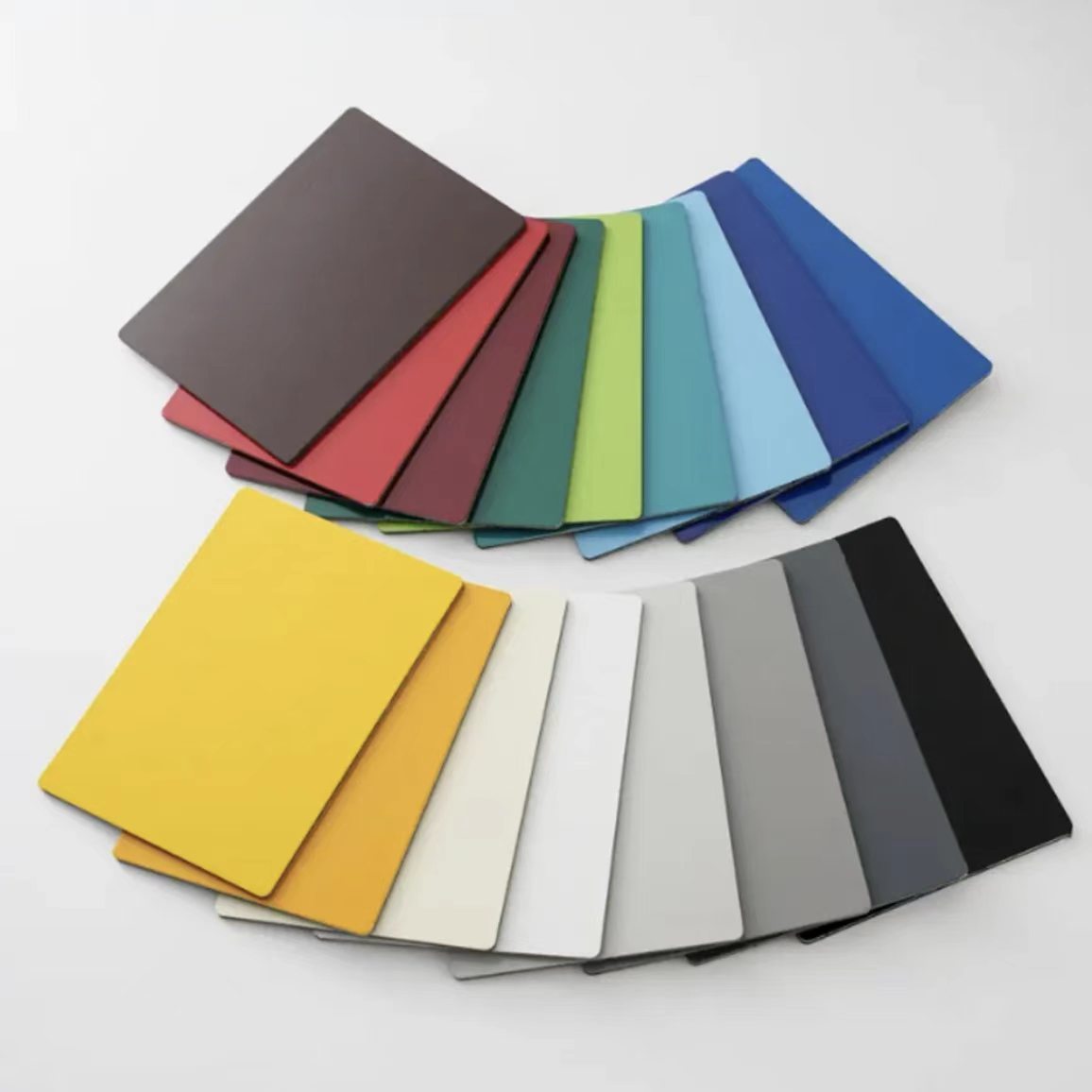
6. Checklist Five: Approve Color and Gloss Samples
Color approval is one of the most important steps in ACP procurement. A small difference in color or gloss can become obvious across a large facade.
Buyers should approve a physical sample before mass production. The sample should show the actual coating system, color, gloss, and finish that the supplier plans to use.
Color Approval Checklist
· Confirm the exact color code.
· Approve a physical coated aluminum sample.
· Record the gloss level.
· Confirm whether the finish is solid, metallic, brushed, or another effect.
· Review the sample under suitable lighting.
· Keep a signed or otherwise traceable reference sample.
· State the permitted color variation in the contract.
· Require written approval before any color or coating change.
Metallic and special-effect colors need extra care. Their appearance may change with viewing angle, lighting, and production conditions.
A digital color image cannot replace a physical sample. Buyers should use the approved sample as the reference for production inspection.
Image Caption: An approved color and gloss sample gives the buyer and supplier a shared reference for ACP production.
Aluminum composite panel PE and PVDF coating color samples for buyer approval.
7. Checklist Six: Confirm the Aluminum and Panel Specifications
The coating is only one part of the finished ACP. Buyers must also define the panel construction and aluminum skin requirements.
A strong coating cannot compensate for an unsuitable panel structure. The purchase contract should cover the aluminum skin, core, total thickness, dimensions, flatness, and intended fabrication method.
Panel Construction Checklist
Item | Details to Specify |
Total panel thickness | Exact nominal thickness and tolerance |
Aluminum skin thickness | Front and rear aluminum thickness |
Aluminum alloy | Required alloy or approved equivalent |
Core material | Core type and applicable fire-performance requirement |
Panel dimensions | Length, width, and tolerance |
Flatness | Agreed flatness or visual acceptance limits |
Surface finish | Color, gloss, texture, and protective film |
Fabrication needs | Cutting, routing, folding, and fixing requirements |
Fire classification | Required test standard and project approval |
The core deserves special attention on building projects. If the project requires a fire-rated ACP, buyers must define the required core type and fire-test performance separately from the coating specification.
Do not accept a coating report as proof of the panel's fire performance. These are different product properties and require different evidence.
8. Checklist Seven: Review the Inspection and Test Plan
A contract should explain how the supplier will prove that the finished panels meet the specification. Without an inspection plan, the buyer may receive test reports that do not match the actual order.
Ask the manufacturer to provide a quality control plan before production. The plan should identify the inspection stages, test methods, sample frequency, acceptance rules, and report format.
Recommended Inspection Stages
Production Stage | Inspection Focus | Required Record |
Incoming materials | Aluminum, core, and coating materials | Material records |
Surface preparation | Cleaning and pretreatment | Process inspection record |
Coating application | Coating product and process settings | Production record |
Curing | Process conditions | Curing record |
Finished coating | DFT, color, gloss, and appearance | Inspection report |
Finished panels | Dimensions, flatness, and surface defects | Final inspection report |
Packing | Protective film and package condition | Packing checklist |
A Simple Quality Approval Flow
Project specification confirmed
↓
Coating product and panel structure approved
↓
Physical sample approved
↓
Production and process checks completed
↓
Finished panel inspection completed
↓
Reports reviewed and order accepted
The buyer should also define who can witness the inspection. For large orders, the contract may include factory inspection or third-party inspection before shipment.
9. Checklist Eight: Check the Warranty Terms
A warranty should support the technical specification, not replace it. Buyers should read the actual warranty document and check what the manufacturer promises to cover.
Different suppliers may use different warranty terms. Coverage can depend on the coating product, installation method, building location, maintenance, and project conditions.
Warranty Questions Before Signing
Question | Why It Matters |
What products and coating types does the warranty cover? | Confirms the exact product scope |
What is the warranty period? | Defines the stated coverage period |
Does it cover color change? | Clarifies appearance protection |
Does it cover chalking? | Defines the surface condition covered |
Does it cover peeling or loss of adhesion? | Clarifies coating-related claims |
What exclusions apply? | Identifies conditions outside coverage |
What maintenance does the owner need to perform? | Prevents avoidable warranty disputes |
How must the buyer submit a claim? | Defines the claim process |
Ask the supplier to attach the warranty document to the purchase agreement or identify the exact document version. Avoid relying on a salesperson's verbal promise.
Also check whether the warranty covers the full panel or only the coating finish. A coating warranty may not cover the core, installation, fabrication, or damage caused by improper handling.
10. Checklist Nine: Define Packaging, Delivery, and Storage
Even a well-coated ACP panel can arrive with damage if the supplier uses poor packaging or handles the goods incorrectly.
The contract should state how the supplier will protect the panels during storage and transport. This is especially important for long-distance export orders.
Packaging and Delivery Requirements
· Use suitable protective film on finished surfaces.
· Prevent panel movement inside the package.
· Protect panel edges and corners.
· Keep the surface clean and dry.
· Identify package quantity, size, and product code.
· Mark the order number and destination details.
· State the required shipping documents.
· Define the process for reporting transport damage.
· Provide storage and handling instructions.
Buyers should also check the protective film requirements. The film should suit the expected storage period and removal conditions.
For long-term storage, follow the manufacturer's instructions. Avoid leaving panels in wet or poorly ventilated packages.
Image Caption: Proper ACP packaging protects coated surfaces and panel edges during storage and international transport.
Export packaging for PE- and PVDF-coated aluminum composite panels with protective film.
11. A Realistic Procurement Example: Two Quotes, Different Specifications
Imagine a contractor receives two quotations for an exterior commercial project. Supplier A offers a lower price and describes the product as "PVDF coated ACP." Supplier B provides a higher-priced quotation with a coating product name, color sample, technical data, inspection plan, and warranty document.
The buyer should not compare these quotations by price alone. First, the buyer should check whether both products meet the same project specification.
Example Quotation Review
Review Item | Supplier A | Supplier B |
Coating description | PVDF | Identified PVDF product |
Coating structure | Not stated | Documented |
DFT requirement | Not stated | Defined in specification |
Color sample | Digital image | Physical sample |
Test reports | Limited | Relevant reports supplied |
Inspection plan | Not included | Included |
Warranty | General statement | Written terms supplied |
Technical review | More information needed | Easier to verify |
Supplier B offers stronger documentation in this example. That does not automatically prove that its panels are better, but it gives the buyer a clearer basis for technical approval.
The buyer should ask Supplier A to complete the missing information before making a final decision. Both suppliers should be evaluated against the same requirements, not against different descriptions.
12. Sample ACP Coating Specification for a Purchase Contract
The following wording can serve as a starting point. Adjust the values, standards, and acceptance limits to match the project and the selected coating product.
Sample Technical Clause
Coating System
The supplier shall provide the coating system approved by the buyer. The coating type shall be identified as PE or PVDF, with the coating manufacturer and product series stated in the technical submittal.
Coating Structure
The supplier shall submit the coating layer structure, including pretreatment, primer, color coat, and any optional clear coat. The supplier shall identify the specified DFT for each layer or the total coating system, as applicable.
Color and Gloss
The supplier shall provide physical color and gloss samples for buyer approval before mass production. Production panels shall match the approved reference sample within the agreed project tolerances.
Performance Evidence
The supplier shall provide relevant technical data sheets and test reports for the agreed coating performance requirements. Each report shall identify the test method, test conditions, sample details, and results.
Quality Inspection
The supplier shall inspect coating thickness, color, gloss, adhesion, and surface appearance according to the approved inspection plan. The supplier shall provide traceable inspection records for the order.
Change Control
The supplier shall not change the coating manufacturer, product series, color, coating structure, or approved panel construction without the buyer's written approval.
Warranty and Delivery
The supplier shall provide the agreed warranty document, packing details, storage instructions, and shipping records before dispatch.
This sample clause does not replace a project-specific technical specification. The buyer should review it with the project engineer and legal or contract team before signing.
13. Final Pre-Signature Checklist
Use this checklist during the final quotation and contract review.
· 
The project application and exposure conditions are defined.
·
·
The coating type is clearly stated as PE or PVDF.
·
·
The coating manufacturer and product series are identified.
·
·
The coating layer structure is documented.
·
·
The DFT requirement and measurement method are stated.
·
·
The color code and gloss level are approved.
·
·
A physical reference sample is signed or recorded.
·
·
The aluminum skin and core specifications are confirmed.
·
·
Fire-performance requirements are stated where needed.
·
·
Relevant test methods and acceptance limits are defined.
·
·
The inspection plan and sampling frequency are agreed.
·
·
Warranty coverage and exclusions are clear.
·
·
Packaging and storage requirements are documented.
Product changes require written approval.
Delivery documents and claim procedures are defined.
If any critical item remains unclear, ask the supplier to revise the technical submittal before signing. A complete specification is easier to inspect and enforce than a general product description.
Conclusion: A Clear Specification Is the Best Protection Before Purchase
PE and PVDF coatings serve different needs. PE can be a practical option for interior and selected applications. PVDF often suits exterior projects that demand stronger weather and color performance.
However, neither coating type should be approved based on its name alone. Buyers should review the coating product, layer structure, test evidence, panel construction, warranty, and inspection plan.
When sourcing a fluorocarbon-coated Alucobond panel, ask the supplier to prove what the product includes and how the manufacturer controls its quality. Put those requirements in the purchase contract before production begins.
A clear ACP coating specification does more than reduce purchasing risk. It gives the supplier, contractor, inspector, and building owner the same technical reference from the first sample to final delivery.