Welcome to Vbond
ACP in Sci-Fi Movies: How Fictional Architecture Predicts Real Materials
Introduction: When Tomorrow's Architecture Arrives Today
There is a moment in almost every science fiction film when the hero steps into a city of the future. Gleaming towers curve toward the sky. Light plays across metallic surfaces that seem to breathe. The architecture itself tells us we have left the present behind.
For decades, these visions existed only on screen—the imaginative work of production designers who built miniature models and matte paintings of worlds to come. But something remarkable has happened in the last twenty years. The materials we use to build real cities have begun to catch up with fiction.
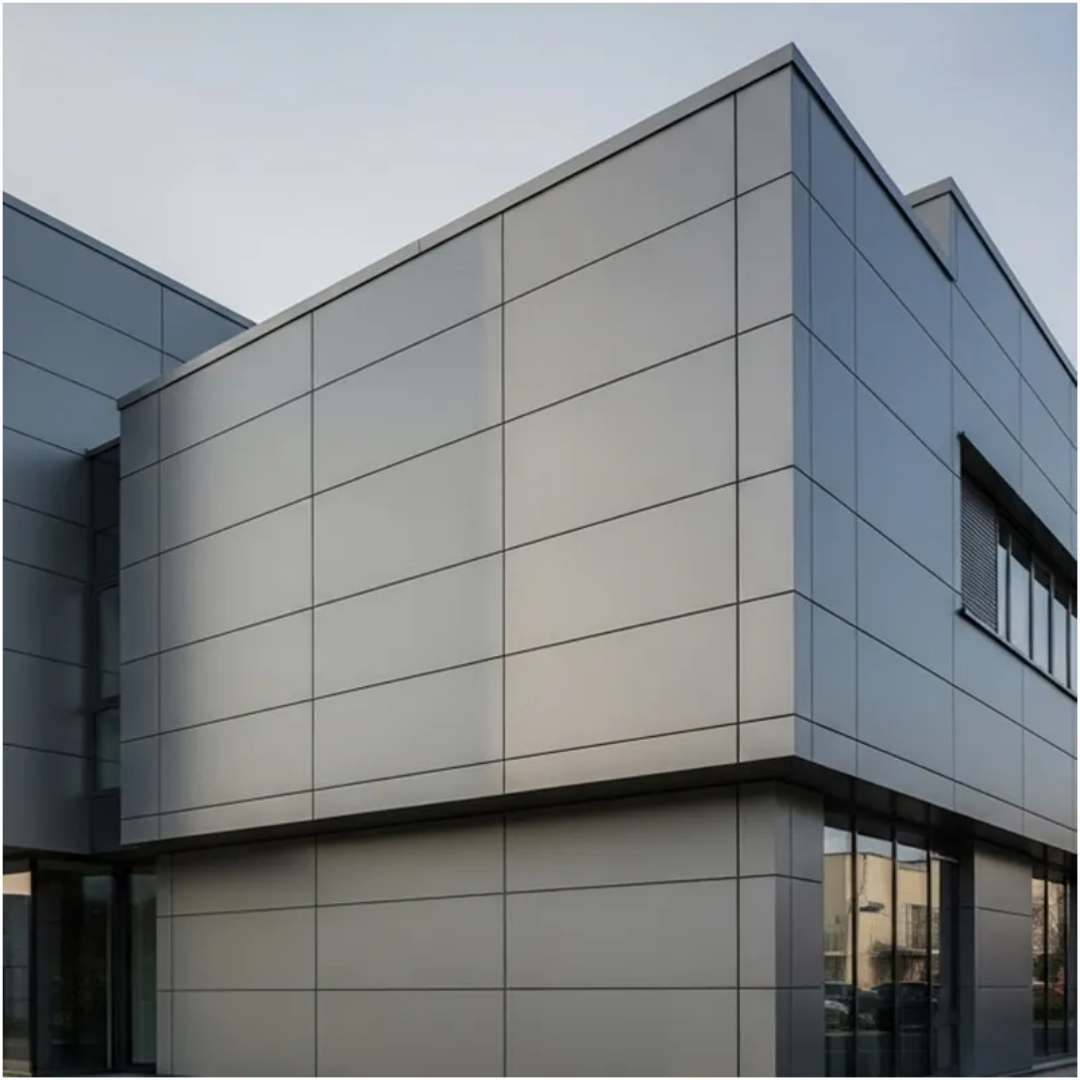
At the heart of this convergence lies Aluminium Composite Panels (ACP). This humble cladding material, born of aerospace engineering in the 1960s, has become the medium through which science fiction architecture is entering the physical world. From Matrix-inspired metal rain curtains in Shanghai to Star Wars-evoking bronze mesh in Melbourne, ACP is quietly fulfilling prophecies that cinema made decades ago.
This article explores the fascinating dialogue between science fiction and material science—and how ACP has become the bridge between imagined futures and built reality.
The Visual Language of Sci-Fi Architecture
What Makes a Building Look "Futuristic"?
Before examining specific examples, it's worth understanding what gives science fiction architecture its distinctive character. Production designers across generations have developed a visual vocabulary that signals "future" to audiences:
Seamless Curves: From the organic forms of Alien's Nostromo to the sweeping arcs of Minority Report, curved surfaces suggest advanced manufacturing capabilities that transcend rectilinear limitations.
Metallic Luminosity: The sheen of polished metal—whether the gleaming white of 2001: A Space Odyssey's Discovery or the burnished gold of Star Wars—communicates technological sophistication.
Parametric Complexity: Complex, non-repeating patterns that appear generated by an algorithm rather than a human hand suggest computational design far beyond current capabilities.
Perforated Surfaces: Screens, grilles, and perforated panels that reveal and conceal simultaneously create depth and mystery.
Monumental Scale: Structures that dwarf human proportion evoke the power of future civilizations.
For decades, these effects required elaborate physical models or, more recently, CGI. But as real-world fabrication technologies have advanced, architects have begun asking: what if we could build this?
The Material That Made It Possible
Why ACP Became the Sci-Fi Material of Choice
Aluminium composite panels possess a combination of properties that make them uniquely suited to realizing science fiction aesthetics:
Formability: ACP can be curved, folded, and shaped into complex geometries that would be prohibitively expensive with solid metal or stone. This enables the organic, flowing forms that define futuristic architecture.
Seamless Appearance: High-quality fabrication allows for continuous surfaces that read as unified sculptural elements rather than assembled components—essential for the "monolithic" look of sci-fi.
Finish Versatility: From mirror-polished chrome to brushed titanium to color-shifting iridescence, ACP coatings can achieve virtually any metallic effect.
Perforation Capability: ACP can be precisely perforated to create images, patterns, or textural effects—turning building skins into communicative surfaces.
Light Weight: The sandwich construction allows large panels to be suspended or cantilevered without massive support structures, enabling the dramatic geometries of sci-fi.
Case Study 1: The Matrix Comes to Shanghai
Iron Rain: 500 Aluminum Plates in Digital Downpour
In October 2024, Shanghai's DoBe WE office park gained a building that could have been lifted directly from the Wachowskis' vision. Designed by Wutopia Lab and dubbed "Iron Rain," the structure's facade consists of 500 white aluminum plates stacked in three layers, creating the illusion of a heavy downpour.
The inspiration was explicit: The Matrix, with its iconic visuals of ever-changing green digits symbolizing the digital reality underlying perceived existence. Architect Yu Ting wanted to capture "the inevitability of digitalization" through architectural form.
But the design goes deeper than visual homage. Each perforated aluminum panel is punched with patterns in Morse code, creating a hidden message that only the initiated can read. The rain theme continues inside, where steel bookshelves are shaped like raindrops, and stepping into the lobby "feels like the rain curtains are being drawn open".
The outdoor space adds another sci-fi layer: black titanium mirrored stainless steel panels create a parallel universe effect, reflecting passersby while concealing hidden gardens. At the center stands a red obelisk inspired by 2001: A Space Odyssey, displaying waterfall-like digital rain graphics that link physical and digital realms.
Ting's observation about the building's occupants is telling: "Two-thirds of the tenants in this building are ultimately creatives—I believe their creativity will be greatly stimulated by this distinctive environment". The sci-fi aesthetic isn't merely decorative; it actively shapes the mindset of those who work within.
Case Study 2: Return of the Jedi in Melbourne
Luna Apartments: Princess Leia's Gold Bikini as Architecture
Few sci-fi references are as unexpected as the inspiration for Melbourne's Luna Apartments. Designed by Elenberg Fraser, this five-story residential building in St Kilda takes its visual cues directly from Star Wars Episode VI—specifically, Princess Leia's infamous gold bikini.
The architects explained their thinking with characteristic candor: "While Luna's curvaceous form echoes the draping lines of Leia's usual white robes, the shimmering gold glass and metal mesh materials are matched perfectly with the colors and textures of the gold brassiere".
The building is wrapped in bronze-colored aluminum mesh from Germany's GKD, mounted on operable shutters that give residents control over privacy and environmental exposure. The effect is extraordinary: the mesh and bronze-tinted glass create outdoor terrace spaces bathed in a soft, metallic glow that the architects describe as "something akin to an eternal sunset, or perhaps like being on a planet in a galaxy far, far away".
Beyond the pop culture reference, the design demonstrates sophisticated thinking about material performance. The mesh serves multiple functions: solar protection, privacy control, weather screening, and aesthetic expression. When interior lights are on, the mesh reflects the interior, maintaining privacy; when exterior lights illuminate the facade, the glass becomes transparent while the mesh prevents views from outside. This dynamic interplay between transparency and concealment—so central to sci-fi aesthetics—is achieved through careful material selection.
Case Study 3: Tobor the Great in London
A 1950s Sci-Fi Robot Guards a London Gateway
Sometimes the connection between sci-fi and architecture is about memory rather than futurity. At Langtry Court in Brockley, South East London, a 2.3m x 1.4m perforated aluminum gate panel depicts Tobor the Great—a robot from a 1950s sci-fi movie.
The reference is historically specific: the site was once occupied by The Ritz cinema, demolished in the 1960s. The last film shown there was "Tobor the Great," a sci-fi film about a robot scientist. Architects Selencky Parsons wanted to "come up with something a bit more interesting than just going with a blank panel, something that could add something to that little corner of Brockley".
The perforated aluminum technology allowed them to transform a functional gate into a storytelling surface. Finished in polyester powder coating RAL 8019 Grey Brown, the panel is lightweight, durable, and fully recyclable—ensuring this glimpse into the area's past will endure for future generations.
This project demonstrates that sci-fi influence isn't always about looking forward. Sometimes it's about honoring the futures that past generations imagined—and the materials that make those memories tangible.
The Technology Behind the Magic
Perforation, Forming, and Finish
The realization of sci-fi aesthetics through ACP relies on three key technological capabilities:
Precision Perforation: Modern CNC equipment can perforate ACP with extraordinary accuracy, creating images, patterns, and textural effects at scales from intimate gate panels to entire building facades. The Shanghai Iron Rain project's Morse code perforations exemplify how this technology enables surfaces that communicate.
Complex Forming: Three-dimensional shaping of ACP has advanced dramatically. As Viva ACP's Nitin Jain notes, "We have been manufacturing 3D facades for the last few years. These facades give an aesthetic look to facades". The company's 3D louvres and panels are manufactured in-house with "impeccable quality".
Advanced Coating: The range of available finishes has expanded exponentially. Viva ACP offers "more than 500 shades" through cutting-edge four-color coating lines. This enables designers to achieve the specific metallic effects that define sci-fi aesthetics—from Corten steel looks to color-shifting iridescence.
The Double Curvature Frontier
The most dramatic sci-fi forms require double-curved surfaces—the compound curves that define organic, futuristic shapes. As described in technical literature on hyperbolic aluminum panels, projects like the Dubai Future Museum demonstrate the current state of the art: 2,100 double-curved aluminum panels creating a "spiral epic" surface where each panel is unique.
This project achieved "graded skin stretching" with individual panels stretched up to 38%, using parametric design to transform Arabic star charts into continuous curved surfaces. The panels feature nanoscale grooves etched into their surfaces, creating "triple optical metaphors" of starfields, dunes, and data streams at different light angles.
While this project used specialized hyperbolic aluminum panels rather than standard ACP, it demonstrates the trajectory of the technology: toward the seamless, complex, luminous surfaces that science fiction has long promised.
Why Science Fiction Inspires Material Innovation
The Psychology of the Future
The relationship between sci-fi and architecture isn't merely aesthetic. There's a deeper psychological dynamic at work. As the Shanghai Iron Rain project demonstrates, buildings that evoke science fiction can shape how occupants think and feel. Creative workers surrounded by Matrix-inspired design may indeed find their creativity stimulated, as architect Yu Ting suggests.
This reflects a broader principle: the spaces we inhabit shape our cognitive possibilities. Science fiction architecture isn't just about looking futuristic—it's about creating environments that encourage futuristic thinking.
The Circular Connection
Interestingly, the sustainability imperatives driving modern material innovation align with science fiction's concern for resource stewardship. As Viva ACP emphasizes, "sustainability is not an afterthought—it is the foundation of our innovation". Their panels are designed to be "modular, recyclable, and environmentally responsible," made from recyclable aluminium and non-toxic cores that ensure "end-of-life recovery without harming the environment".
This circular approach—designing for disassembly and reuse—echoes science fiction's vision of closed-loop future societies where waste is eliminated. The material that enables our most futuristic buildings is also our most responsible choice.
The Future: Where Sci-Fi and ACP Are Heading
What Comes Next
Several trajectories suggest where the convergence of science fiction and ACP may lead:
Dynamic Surfaces: Buildings that change appearance in response to environmental conditions or user interaction. The Dubai Future Museum's triple optical metaphors—shifting between starfield, dune, and data stream depending on light angle—point toward facades that are never static.
Integrated Technology: ACP surfaces that incorporate lighting, display, or sensing capabilities. The Shanghai Iron Rain project's integration of digital rain graphics on its obelisk suggests how physical and digital surfaces may merge.
Biomorphic Complexity: Increasingly sophisticated parametric design and fabrication will enable forms that approach the organic complexity of living systems. The "graded skin stretching" techniques developed for complex curved panels will become more accessible.
Material Authenticity: As coating technologies advance, the distinction between "real" and "simulated" materials may become irrelevant. When an ACP panel can perfectly replicate the appearance of Corten steel—as demonstrated in the JAX Studio project—the question becomes not "what is it made of" but "what can it do".
The Architects Leading the Way
Firms around the world are pushing these boundaries. Wutopia Lab in China brings explicit sci-fi references into built form. Elenberg Fraser in Australia proves that pop culture inspiration can yield sophisticated architectural results. Selencky Parsons in London demonstrates how perforated aluminum can turn functional elements into storytelling surfaces.
These architects understand that science fiction isn't about prediction—it's about possibility. By building the futures that cinema imagined, they make those possibilities tangible, creating spaces that inspire the next generation of dreamers.
Conclusion: The Future Is Already Here
In his famous observation, science fiction writer William Gibson noted that "the future is already here—it's just not very evenly distributed." The same could be said of sci-fi architecture. The gleaming, curved, luminous buildings that once existed only on screen are now appearing in cities around the world, realized through the extraordinary capabilities of aluminium composite panels.
From Shanghai's digital rain curtains to Melbourne's Star Wars-evoking bronze mesh, from London's robot-guarded gateway to Dubai's parametric starscape, ACP is proving itself the material through which imagination becomes architecture.
For architects, developers, and building owners, the lesson is clear: the tools to build tomorrow are available today. The question is no longer whether we can realize science fiction visions—but which visions we choose to make real.
As the technology continues to advance—curves becoming more complex, finishes more luminous, integration more seamless—the boundary between fictional and real architecture will continue to blur. And standing at that boundary, making both sides possible, will be the humble aluminium composite panel.
The future of architecture looks like science fiction because, increasingly, it is.






