Welcome to Vbond
Short-Term Project vs Long-Life ACM: A PE/PVDF Decision Rule
Introduction: Match the Coating to the Project Life
Choosing an aluminum composite material (ACM) panel is not just a matter of comparing prices. Buyers must also consider how long the building will remain in service, how the facade will perform, and how much maintenance the project can accept.
For some projects, a polyester (PE) coated panel offers a practical balance between cost and performance. For others, a fluoropolymer (PVDF) coating provides better long-term resistance to weathering and color change.
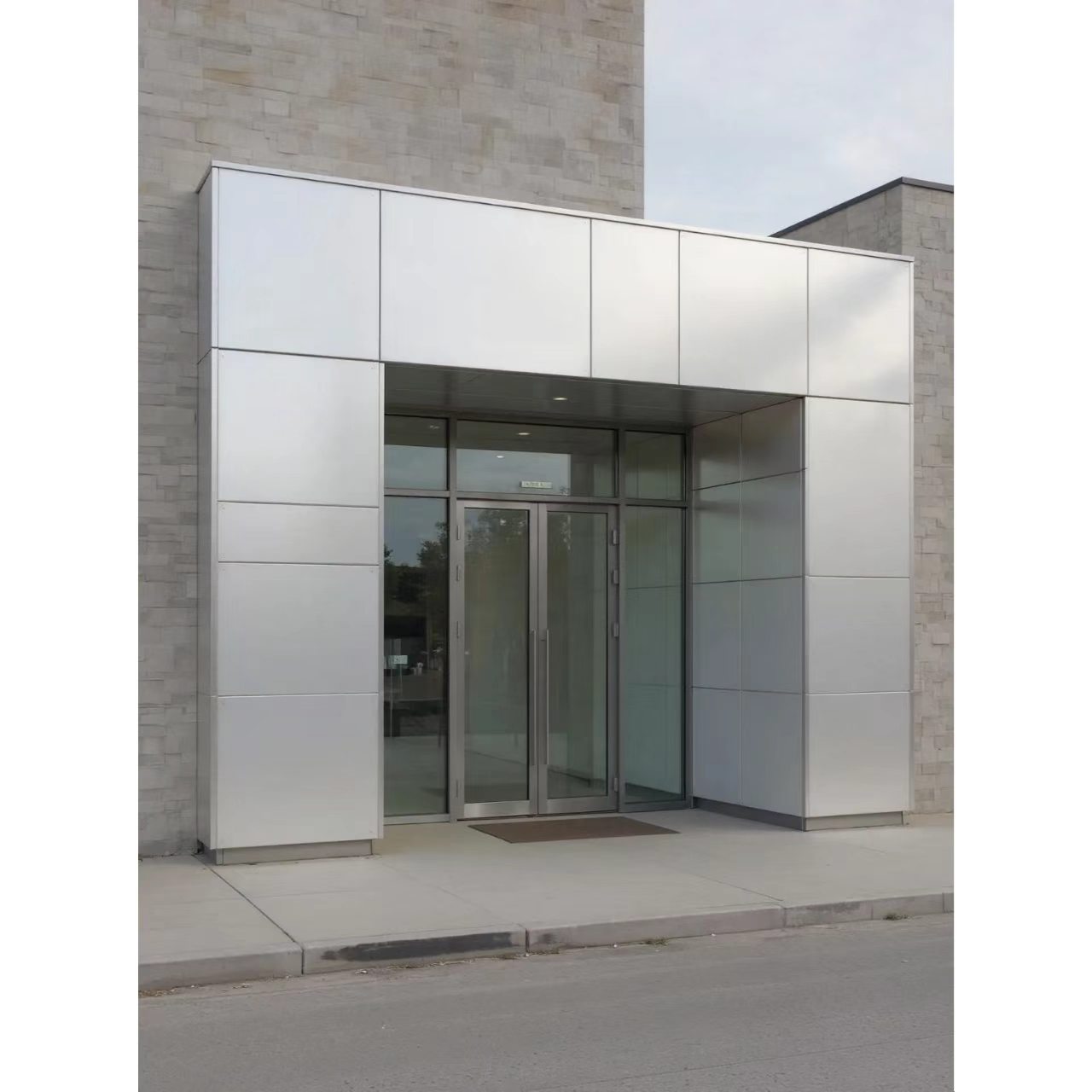
The key is to match the coating system to the expected service period and project requirements. A PE Alucobond sheet may suit a short-term commercial project, interior application, or temporary building. A PVDF-coated ACM panel may be a better choice for a permanent facade exposed to strong sunlight, rain, and changing temperatures.
This guide explains how to make that decision. It also covers technical specifications, project examples, and purchasing checks that help buyers select the right ACM coating.
1. What Makes PE and PVDF Coatings Different?
PE and PVDF are two common coating options for aluminum composite panels. They use different resin systems, which affect their weather resistance, appearance retention, and typical applications.
PE Coating: A Practical Choice for Controlled Applications
PE stands for polyester. PE coatings offer a smooth finish, a wide range of colors, and a competitive purchase price.
A PE Alucobond sheet can work well in applications where outdoor exposure is limited or the required service period is relatively short. Buyers often consider PE panels for interior decoration, retail fit-outs, temporary structures, and selected low-exposure exterior projects.
However, PE coatings generally offer less resistance to long-term UV exposure than high-quality PVDF systems. Strong sunlight and harsh weather can cause faster color change, gloss loss, or surface degradation.
PVDF Coating: Designed for Long-Term Weather Exposure
PVDF stands for polyvinylidene fluoride. It is a fluoropolymer coating system known for its resistance to UV radiation, weathering, and chemical exposure.
A properly manufactured PVDF-coated ACM panel can retain its appearance longer under demanding outdoor conditions. This makes it a common choice for commercial facades, public buildings, airports, and other projects with long service expectations.
PVDF panels usually cost more than comparable PE panels. Buyers should evaluate that extra cost against the project's exposure conditions, appearance requirements, and expected ownership period.
PE vs. PVDF: Key Differences
Comparison | PE Coating | PVDF Coating |
Main resin type | Polyester | Fluoropolymer |
Initial material cost | Usually lower | Usually higher |
UV resistance | Moderate | Generally higher |
Color retention | More limited under strong exposure | Generally better |
Weather resistance | Suitable for selected applications | Better suited to demanding exterior exposure |
Typical applications | Interior, retail, temporary, selected low-exposure projects | Permanent facades, public buildings, exposed commercial projects |
Long-term appearance | More dependent on exposure and maintenance | Generally more stable |
Best selection factor | Budget and limited exposure | Long-term facade performance |
Actual performance depends on the coating formulation, resin content, coating thickness, aluminum pretreatment, production process, and installation quality. Buyers should compare verified product specifications rather than rely on the coating name alone.
2. The Main Decision Rule: Project Duration and Exposure
Project duration provides a useful starting point, but it should not determine the coating choice by itself.
A temporary structure in a hot, sunny region may need stronger weather resistance than a permanent interior wall. Likewise, a permanent facade under a deep roof overhang may face less direct exposure than an exposed coastal building.
Use two questions to guide the decision:
1. How long must the panel maintain its required appearance and function?
2. How severe will the panel's actual exposure conditions be?
A Practical PE/PVDF Selection Guide
Project Type | Expected Use | Exposure Level | Suggested Starting Point |
Indoor retail decoration | Short to long term | Very low | PE |
Exhibition booth | Temporary | Low | PE |
Temporary sales office | Short term | Low to moderate | PE, subject to exposure |
Commercial interior wall | Long term | Very low | PE |
Retail facade renovation | Medium term | Moderate | PE or PVDF, based on exposure |
Standard commercial building facade | Long term | Moderate to high | PVDF |
Airport or public building facade | Long term | High | PVDF |
Coastal commercial facade | Long term | High | PVDF with suitable corrosion protection |
Industrial building exterior | Project dependent | Moderate to high | Evaluate PVDF and the full panel system |
This table provides general guidance, not a substitute for project specifications. Local building codes, fire requirements, climate, and warranty conditions may change the final choice.
The Decision Rule in One Sentence
Choose PE when the project has limited exposure, a controlled appearance requirement, and a suitable budget target. Choose PVDF when long-term outdoor appearance and weather resistance are critical.
3. A Simple Decision Flow for ACM Buyers
Procurement teams can use the following process before requesting quotations.
Step 1: Identify the application
· Interior decoration
· Temporary structure
· Retail or commercial renovation
· Permanent exterior facade
Step 2: Estimate the required service period
· Short-term: limited project duration or planned replacement
· Medium-term: several years of expected use
· Long-term: permanent building envelope or long-term asset
Step 3: Assess exposure
Check direct sunlight, rainfall, temperature changes, humidity, salt spray, pollution, and chemical contact.
Step 4: Set the appearance requirement
Decide whether minor color variation is acceptable or whether the facade must maintain a consistent appearance over a long period.
Step 5: Compare the complete specifications
Review coating type, coating thickness, aluminum skin thickness, core material, panel dimensions, fire performance, and warranty conditions.
Step 6: Select the coating
· PE for suitable interior, temporary, and controlled applications.
· PVDF for demanding and long-term exterior applications.
PE/PVDF Decision Flow
Start
|
Where will the panel be used?
|
+-------+--------+
| |
Interior Exterior
| |
Limited UV? Assess climate
| |
Yes High UV, rain,
| salt or pollution?
PE |
+-----+-----+
| |
Low High
| |
Compare project Long-term
duration appearance?
| |
PE or PVDF +---+---+
| |
Yes No
| |
PVDF Compare full
specifications
This flowchart is a screening tool. Final selection must follow the approved project specification and applicable local requirements.
4. Four Project Scenarios: When Should Buyers Choose PE or PVDF?
Real project conditions make coating selection easier to understand. The following examples show how buyers can apply the decision rule.
Case 1: A Temporary Retail Pop-Up Store
A retail brand plans to operate a pop-up store for 12 months. The project needs attractive wall panels, a clean surface, and a controlled material budget.
The panels will cover an indoor wall and a small entrance feature under a roof. Direct sunlight and rain exposure are limited.
Suggested choice: PE-coated ACM.
A PE Alucobond sheet can provide the required decorative finish without paying for exterior weathering performance that the project may not need. The buyer should still confirm surface quality, color consistency, panel flatness, and fabrication requirements.
Case 2: A Permanent Office Building
A developer plans a commercial office building with an expected service period of several decades. The facade will receive direct sunlight and regular rainfall.
The owner wants consistent color across the facade and does not plan frequent panel replacement.
Suggested choice: PVDF-coated ACM.
PVDF offers a stronger starting point for long-term exterior appearance. The buyer should also check the coating specification, aluminum thickness, core composition, fixing system, and project warranty.
Case 3: A Shopping Mall Renovation
A shopping mall plans to replace its entrance cladding and selected facade sections. The renovation budget is limited, but the owner expects the new panels to remain in place for many years.
The project includes both covered areas and exposed exterior surfaces.
Suggested choice: A mixed specification may work better.
Use PE for suitable interior or protected decorative sections. Specify PVDF for exposed exterior areas where long-term weather resistance matters.
This approach avoids applying the same coating to every area without considering actual exposure. It can also help the buyer control material costs while protecting the most exposed sections.
Case 4: A Coastal Commercial Building
A hotel near the coast needs new exterior cladding. The facade faces strong sunlight, high humidity, wind-driven rain, and airborne salt.
Suggested choice: PVDF, with additional corrosion protection checks.
PVDF can improve coating durability, but it does not solve every corrosion risk. Buyers should also review aluminum alloy and temper, pretreatment, edge protection, fasteners, drainage details, and the suitability of the complete facade system for coastal conditions.
The panel manufacturer should provide clear technical data for the intended environment.
5. Do Not Judge a PE Alucobond Sheet by Price Alone
A low quotation does not always mean a better purchase. Buyers need to compare the complete panel specification.
Two PE-coated ACM products may have different performance because their materials and manufacturing processes differ. The same applies to PVDF products.
Before placing an order, review the following technical factors.
5.1 Coating Formulation
Ask the manufacturer to identify the coating system and provide its technical data sheet.
For PE products, confirm the coating type and intended application. For PVDF products, confirm the resin system and whether the coating meets the project specification.
Do not accept a coating label as the only proof of performance.
5.2 Coating Thickness
Coating thickness affects surface protection and must match the product specification.
Ask the supplier to state the coating thickness and explain the measurement method. Confirm whether the quoted value refers to the total coating system or a specific coating layer.
5.3 Aluminum Skin Thickness
Aluminum skin thickness affects panel stiffness, forming performance, and resistance to handling damage.
A panel with a thicker coating does not automatically have stronger aluminum skins. Buyers should check the aluminum thickness separately from the overall panel thickness.
5.4 Pretreatment and Adhesion
The coating needs a properly prepared aluminum surface to achieve reliable adhesion.
Ask about the pretreatment process and relevant adhesion test results. Poor pretreatment can lead to coating failure even when the coating material itself has good properties.
5.5 Core Material and Fire Performance
The core material affects panel weight, fire behavior, and suitability for different building types.
Buyers should specify the required core type and fire classification. Confirm that the complete panel assembly meets local building codes and project requirements.
Do not assume that a PE or PVDF coating determines the panel's fire performance. Coating type and core fire classification are separate specifications.
5.6 Color Consistency Between Batches
Large projects may require several production batches. Color differences between batches can create visible lines across a facade.
Ask the manufacturer to confirm color tolerance, sample approval procedures, and batch control. For large orders, approve a production sample before mass manufacturing.
6. Testing and Documents Buyers Should Request
A professional supplier should support product claims with clear technical documents.
The following tests and records can help buyers evaluate coating performance. Each test has a specific purpose, so no single test can prove every aspect of long-term service life.
Test or Document | What It Checks | Why Buyers Need It |
ASTM G154 | Fluorescent UV exposure of nonmetallic materials | Evaluates coating behavior under controlled UV and moisture cycles |
ASTM G155 | Xenon-arc exposure | Evaluates weathering behavior under controlled laboratory conditions |
ASTM D2244 | Color difference calculation | Measures color change using colorimetric data |
ASTM D4214 | Chalking of exterior paint films | Evaluates chalking on the coating surface |
ASTM D3359 | Coating adhesion by tape test | Checks coating adhesion under the specified test method |
ASTM D523 | Specular gloss | Measures surface gloss |
Technical Data Sheet (TDS) | Product specifications | Confirms the quoted panel configuration |
Warranty Document | Contractual coverage | Defines coverage, exclusions, and claim conditions |
Accelerated weathering tests help compare materials under controlled conditions. They do not provide a universal conversion from laboratory hours to outdoor service years.
For a fair comparison, request test reports for the exact coating system and product configuration being quoted.
7. How to Compare PE and PVDF Quotations Fairly
Buyers often receive quotations from several suppliers. A fair comparison requires the same technical baseline.
If one supplier quotes a PE panel with a 0.30 mm aluminum skin and another quotes a PVDF panel with a 0.50 mm skin, the price difference does not come from the coating alone.
Use a quotation comparison sheet with the following items:
Specification | Supplier A | Supplier B | Supplier C |
Coating type | PE/PVDF | PE/PVDF | PE/PVDF |
Coating brand or system | Confirm | Confirm | Confirm |
Aluminum skin thickness | Confirm | Confirm | Confirm |
Total panel thickness | Confirm | Confirm | Confirm |
Core material | Confirm | Confirm | Confirm |
Fire classification | Confirm | Confirm | Confirm |
Panel size | Confirm | Confirm | Confirm |
Color and finish | Confirm | Confirm | Confirm |
Coating test reports | Confirm | Confirm | Confirm |
Warranty terms | Confirm | Confirm | Confirm |
Lead time | Confirm | Confirm | Confirm |
Packaging and shipping | Confirm | Confirm | Confirm |
Compare like with like before selecting a supplier. This prevents buyers from choosing a lower price that comes with a thinner aluminum skin, different core, or weaker coating specification.
8. When Does a PE Alucobond Sheet Make Sense?
PE panels remain useful when the project does not require premium long-term exterior weathering performance.
Common suitable applications include:
· Interior wall cladding
· Ceiling decoration
· Retail display structures
· Exhibition booths
· Temporary commercial buildings
· Shop interiors
· Signage and decorative panels
· Covered areas with limited outdoor exposure
For these applications, buyers should focus on surface finish, flatness, color consistency, processing quality, and the required fire performance.
A PE Alucobond sheet should not be selected for a demanding exterior facade simply because it has a lower purchase price. The coating must match the real exposure and expected appearance requirements.
9. When Should Buyers Upgrade to PVDF?
PVDF deserves serious consideration when the project places a high value on long-term exterior appearance.
Typical applications include:
· Permanent commercial building facades
· Airports and transportation buildings
· Public and institutional buildings
· Large shopping centers
· Hotels and resorts
· Coastal developments
· Buildings in regions with strong UV exposure
· Projects with strict color-retention requirements
The upgrade becomes more important when the facade is difficult to access for maintenance or when replacement would disrupt building operations.
However, PVDF is not a substitute for good panel design, correct installation, or regular inspection. Buyers should evaluate the complete facade system, not only the coating.
10. Common Procurement Mistakes
Mistake 1: Selecting PE Only Because the Quotation Is Lower
A lower initial price may not match the project's expected service requirements. Check the intended use before making the final decision.
Mistake 2: Specifying PVDF for Every Application
Not every project needs a high-performance exterior coating. For indoor decoration and temporary structures, PE may provide the required finish at a more suitable cost.
Mistake 3: Comparing Coating Names Instead of Product Specifications
The words PE and PVDF do not describe every part of panel quality. Review resin formulation, coating thickness, pretreatment, aluminum skin thickness, and manufacturing control.
Mistake 4: Ignoring Local Climate
A building in a mild inland climate faces different conditions from one in a coastal or high-UV region. Exposure should influence the coating specification.
Mistake 5: Treating Warranty Period as a Performance Guarantee
A warranty is a contractual document with defined coverage and exclusions. Read the actual terms and confirm that they match the project's location, application, and maintenance plan.
11. A Practical Buyer Checklist Before Ordering
Use this checklist when requesting a quotation for PE or PVDF aluminum composite panels.
Project requirement
Confirm whether the application is interior or exterior.
Define the expected service period.
Identify local UV, rainfall, humidity, salt, and pollution conditions.
Confirm the required color and surface finish.
Define the project's fire-performance requirements.
Panel specifications
Confirm PE or PVDF coating type.
Request the coating technical data sheet.
Confirm coating thickness.
Confirm aluminum skin thickness.
Confirm total panel thickness and core material.
Review flatness, color tolerance, and batch consistency.
Quality and delivery
Request relevant test reports.
Review the warranty document and exclusions.
Approve a color and finish sample.
Confirm production lead time.
Confirm packaging, loading, and delivery conditions.
A clear specification reduces quotation errors and makes supplier comparisons more reliable.
Conclusion: Buy for the Project, Not Just for the Price
The right ACM coating depends on the building's purpose, exposure, appearance requirements, and expected service period.
A PE Alucobond sheet can be a sensible choice for interior decoration, temporary structures, and selected low-exposure applications. It gives buyers a cost-conscious option when premium exterior weather resistance is not necessary.
PVDF is generally the stronger choice for permanent facades exposed to demanding weather conditions. It offers better resistance to UV-related color change and surface degradation when manufacturers use a suitable coating system and follow proper production controls.
The best procurement decision is not always the cheapest panel or the most expensive coating. It is the panel that meets the project's technical requirements without paying for performance the building does not need.
Before ordering, define the application, service period, exposure level, and required appearance. Then compare PE and PVDF products using the same technical specification.