Welcome to Vbond
The Role of Aluminum Panel Skin Temper (H14 vs H16) in Crack Resistance During Folding
When aluminum composite panels crack at the fold line, the instinct is to blame the fabrication technique. Sometimes the groove depth is wrong. Sometimes the bending pressure is uneven. But there is another variable that is often overlooked until the damage is done: the temper of the aluminum skin itself.
The aluminum skins bonded to the core are not all the same. They are supplied in different tempers—most commonly H14 and H16—and the difference between these two tempers is the difference between a clean, structural fold and a cracked, rejected panel.
This guide explains the metallurgical distinction between H14 and H16 tempers, how each behaves under bending stress, and how to specify the correct temper for your fabrication requirements.
1. What Aluminum Temper Means
Temper designations describe the mechanical condition of aluminum after processing. The "H" series indicates strain-hardened aluminum—material that has been work-hardened by rolling to increase its strength.
The number following the H indicates the degree of hardening:
Temper | Hardness Level | Work Hardening Degree |
H12 | 1/4 hard | 25% hard, 75% soft |
H14 | 1/2 hard | 50% hard, 50% soft |
H16 | 3/4 hard | 75% hard, 25% soft |
H18 | Full hard | 100% hard |
As the temper number increases, strength increases—but ductility (the ability to stretch without breaking) decreases.
This is the fundamental trade-off: stronger material is more brittle.
2. The Mechanical Differences: H14 vs. H16
Tensile and Yield Strength
Higher temperature means higher strength. Research data shows the progression clearly:
For 3003 aluminum alloy (typical for ACP skins):
Temper | Tensile Strength (MPa) | Yield Strength (MPa) | Elongation (%) |
H14 | 145-195 | 125 | 2-4% |
H16 | 170-210 | 150 | 1-2% |
Source:
For 1100 aluminum alloy:
Temper | Ultimate Strength (MPa) | Yield Strength (MPa) |
H14 | 138 (minimum) | 117 (minimum) |
H16 | 165 (minimum) | 145 (minimum) |
Source:
The numbers show that H16 is approximately 15-20% stronger than H14. But the critical difference is in elongation—the measure of how much the material can stretch before fracturing.
H14 has 2-4% elongation. H16 has only 1-2% elongation. This means H16 can stretch only half as far as H14 before cracking.
The "Springback" Factor
H16 aluminum also exhibits greater springback—the tendency to return to its original shape after bending. While this can be beneficial for maintaining precise angles, it requires higher bending forces and more precise tooling to achieve the final fold.
3. How Temperature Affects Fold Line Crack Resistance
The Bending Mechanism
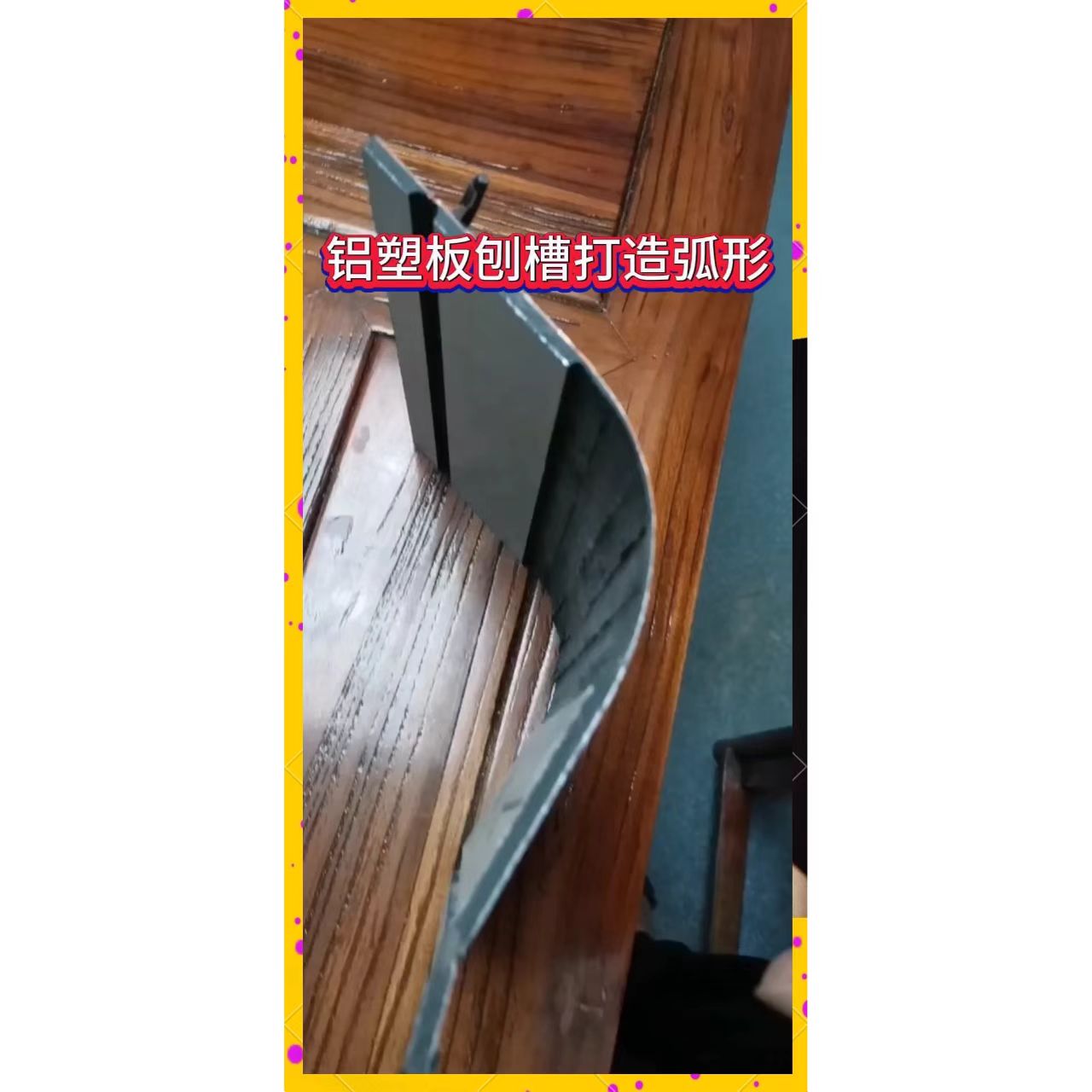
During V-groove folding, the remaining aluminum skin (approximately 0.2-0.3mm thick) acts as a living hinge. It must stretch to accommodate the 90-degree bend. The skin does not compress on the inside of the fold—it stretches on the outside.
The amount of stretch required is determined by the bend radius. For a sharp 90-degree corner (approaching a zero-radius bend), the outer surface of the aluminum must stretch approximately 57% of its original length. This is an extreme demand on any metal.
H14: The Forgiving Temper
H14 is strain-hardened to half-hard. It retains sufficient ductility to stretch significantly before reaching its fracture point. The 2-4% elongation specification is a minimum; actual performance can be higher with quality material.
Why H14 resists cracking:
- Higher elongation allows more stretch before failure
- Lower strength reduces springback force
- More forgiving of minor groove depth variations
- Better suited for cold bending without heat assistance
Best for: Standard fabrication, complex folded geometries, panels requiring multiple bends, and applications where fabrication tolerances are not extremely tight.
H16: The High-Strength, High-Risk Temper
H16 is strain-hardened to three-quarters hard. It is significantly stronger but also significantly more brittle. The 1-2% elongation means there is very little margin for error.
Why H16 cracks more easily:
- Lower elongation means the skin reaches its fracture limit faster
- Higher strength creates greater internal stress at the bend line
- Requires near-perfect groove depth control
- Less tolerant of material inconsistencies
Best for: Applications where higher strength is required for structural reasons, and where fabrication can be performed with CNC precision and heat assistance.
4. The Fabrication Variables That Interact with Temper
Temper does not act in isolation. The following factors determine whether a given temper will crack or succeed:
Groove Depth Control
For H14, leaving 0.2-0.3mm of remaining skin is standard. For H16, some fabricators recommend leaving slightly more material—0.3-0.4mm—to provide additional margin before the fracture point.
Bend Radius
Sharper bends concentrate stress more intensely. For H16, even a slightly larger internal radius can dramatically reduce crack risk. Where H14 can tolerate a near-zero radius fold, H16 may require a radius of 0.5-1.0mm.
Temperature
Cold aluminum is more brittle. Heating the panel to 40-50°C before bending increases ductility and reduces crack risk. This is particularly important for H16.
Tool Condition
Dull V-groove bits create micro-damage at the groove base. For H14, this is manageable. For H16, these micro-flaws become crack initiation points.
5. When to Specify H14 vs. H16
Application | Recommended Temper | Rationale |
Standard architectural cladding | H14 | Sufficient strength; excellent crack resistance |
Complex folded cassettes | H14 | Multiple bends require ductility |
Deep-drawn or stretched shapes | H14 | Higher elongation required |
High-wind or structural applications | H16 | Higher strength is needed for load resistance |
Large-format panels with minimal folding | H16 | Fewer bends; strength prioritized over formability |
Cold climate installations | H14 | Retains flexibility at low temperatures |
Precision CNC fabrication with heat assist | H16 | A controlled process can manage lower ductility |
General rule: Unless you specifically need the higher strength of H16, specify H14. The crack resistance advantage of H14 outweighs the strength advantage of H16 for most facade applications.
6. Procurement Specifications for Temper
To ensure you receive the correct temperature for your application, include these specifications in your purchase orders:
Specification Clause 1: Temper Designation
"Aluminum skins shall be supplied in H14 temper (half-hard) minimum. H16 temper shall be used only when specified and shall require documented fabrication protocols, including groove depth tolerance and bend radius requirements."
Specification Clause 2: Mechanical Properties
"Supplier shall provide mill certificates documenting tensile strength, yield strength, and elongation for each batch. Elongation shall meet or exceed 2% for H14 and 1.5% for H16."
Specification Clause 3: Formability Testing
"Upon request, supplier shall provide formability test results demonstrating that the supplied temper can achieve a 90-degree bend over a zero-radius tool without cracking when properly V-grooved."
7. Conclusion
The choice between H14 and H16 aluminum skin temper is a choice between strength and ductility. H14 offers moderate strength with excellent formability—it bends without cracking. H16 offers higher strength but reduced ductility—it is more likely to crack at the fold line.
For most aluminum composite panel applications, H14 is the correct choice. It provides more than sufficient strength for facade cladding while offering the ductility required for reliable folding. H16 should be reserved for applications where structural demands genuinely require higher strength, and where fabrication can be performed with the precision and temperature control necessary to manage its lower ductility.
When you specify the wrong temperature, you are not just choosing a different number on a datasheet. You are determining whether your folded corners crack or hold.