Welcome to Vbond
The Thickness Test: Does a 4mm ACP Panel Perform Twice as Well as 2mm?
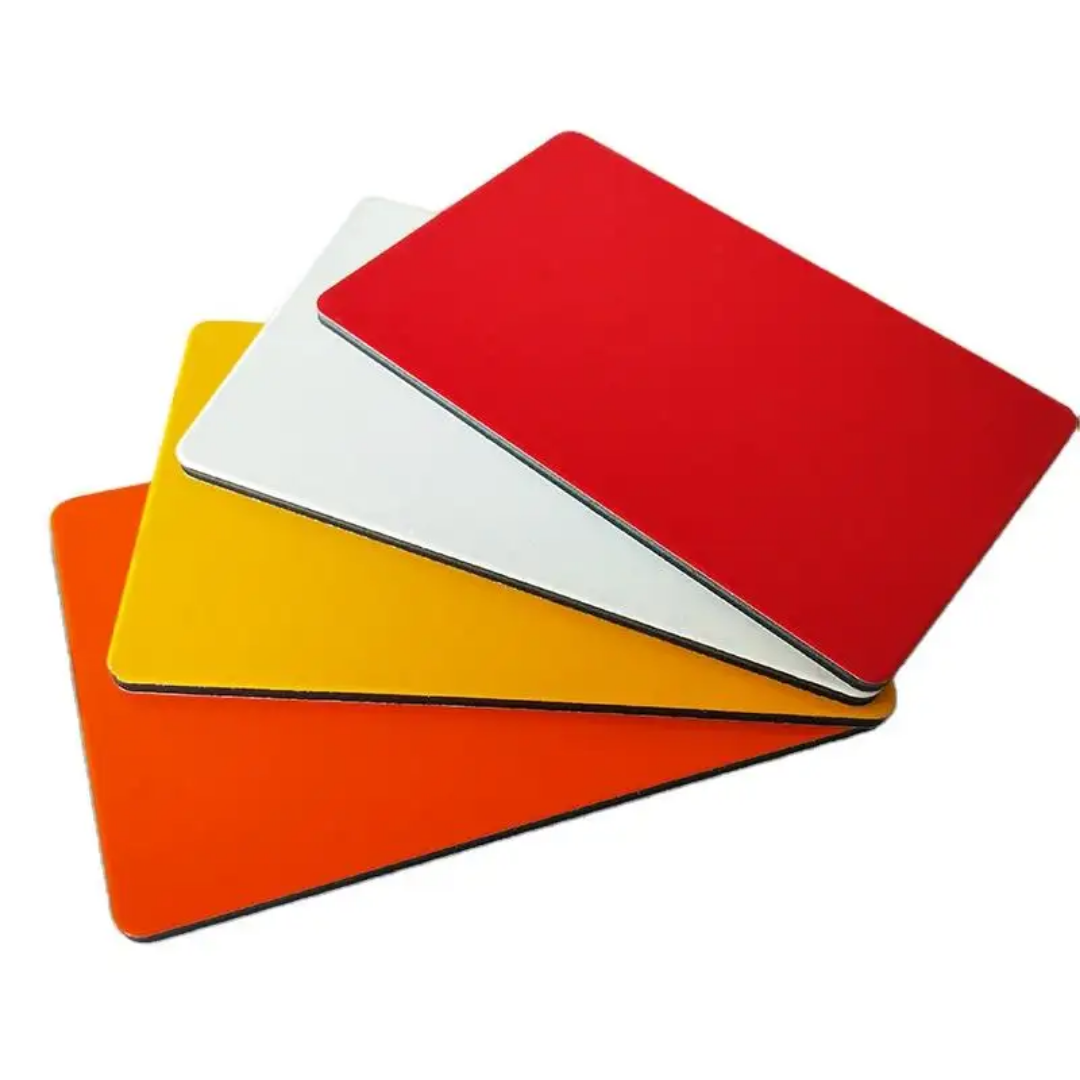
When specifying Aluminum Composite Panels (ACP), thickness is one of the most discussed but often misunderstood parameters. A common and seemingly logical assumption is that a 4mm ACP panel must perform exactly twice as well as a 2mm panel. However, in the world of material science and building physics, this linear relationship is a myth.
This article delves into the engineering reality, explaining how thickness impacts key performance areas like stiffness, flatness, wind load resistance, and thermal performance. We will clarify why a 4mm panel is not simply a "double" of a 2mm panel but represents a significant leap in structural capability for specific applications.
Understanding ACP Structure: More Than Just "Thickness"
To understand performance, we must first break down what "thickness" means in an ACP. A standard panel is a composite sandwich:
Two Aluminum Skins: Typically ranging from 0.2mm to 0.5mm each.
A Core: Usually polyethylene (PE) or a fire-retardant mineral compound.
The total thickness (e.g., 2mm, 3mm, 4mm) is the combined measurement of these three layers. A thicker panel primarily achieves its increased size by using a thicker core material, while the aluminum skin thickness may or may not increase proportionally.
Performance Factor Breakdown: The Non-Linear Reality
Let's examine how panel thickness affects critical performance metrics.
1. Stiffness and Flatness: The Power of the Cube
This is the most critical and non-linear relationship. The stiffness of a panel—its resistance to bending and deformation—is proportional to the cube of its thickness.
What this means in practice:
A 3mm panel is not 50% stiffer than a 2mm panel. It is approximately (3/2 ³ = 3.375 times stiffer.
A 4mm panel is not twice as stiff as a 2mm panel. It is a dramatic (4/2)³ = 8 times stiffer.
This exponential increase in stiffness is why thicker panels exhibit superior flatness and resist "oil-canning" (a visible waviness or buckling effect), especially on large, uninterrupted facade areas or in strong sunlight.
2. Wind Load Resistance
Thicker, stiffer panels can span greater distances between supports on a substructure. A 4mm panel can typically withstand higher wind pressure (Pa/kN/m²) than a 2mm panel using the same support spacing. Alternatively, for the same required wind load, a 4mm panel may allow for a wider spacing of support brackets, potentially reducing material and installation costs for the substructure.
3. Impact Resistance and Durability
A thicker core provides a greater buffer against impact. A 4mm panel will generally offer better dent resistance from hail, debris, or accidental contact during construction and maintenance than a 2mm panel. This translates to better long-term aesthetic durability.
4. Thermal and Acoustic Performance
While thickness plays a role, the improvement is more linear and less dramatic. A thicker core provides a slightly larger air gap within the panel's insulation path, which can contribute to marginally better thermal insulation and sound-damping properties. However, the primary thermal performance of a rainscreen system comes from the insulation layer behind the panels, not the panels themselves.
Application Guidelines: Choosing the Right Thickness
The choice is not about "good vs. bad," but about right-sizing for the application.
Use 2mm-3mm ACP Panels for:
Interior Applications: Feature walls, ceilings, shop fittings, exhibition stands.
Signage and Fascias: Where structural loads are minimal.
Small-scale or residential projects with small panel sizes and short spans.
Retrofit projects where minimizing added weight is crucial.
Use 4mm (and above) ACP Panels for:
High-Rise Building Facades: Where wind loads are significant.
Large-Format Panels: To achieve a sleek, seamless appearance with maximum flatness and minimal oil-canning.
Areas Prone to Severe Weather: Such as coastal regions with high wind or hail risk.
Architectural features requiring enhanced rigidity: Long canopies, soffits, or complex 3D shapes.
Cost Considerations: Is Thicker Always Better?
A 4mm panel costs more than a 2mm panel due to increased material use. The key question for specifiers is: Does my project require the exponential performance gain?
For a standard low-rise building with appropriately spaced supports, a 3mm panel often provides the optimal balance of cost, weight, and performance. Upgrading to 4mm may be an unnecessary expense. Conversely, on a tall building or a design with very large panels, specifying 4mm is not an extravagance but a necessary engineering requirement to ensure performance, safety, and aesthetics.
Conclusion: Performance is Exponential, Not Linear
The answer to the title's question is a definitive no. A 4mm ACP panel does not perform "twice as well" as a 2mm panel; in its most critical function (stiffness), it performs eight times better.
Choosing the correct ACP thickness is a fundamental engineering decision. It requires evaluating:
1. Project-Specific Wind Load Calculations
2. Desired Panel Size and Support Grid Spacing
3. Aesthetic Requirements for Flatness
4. Environmental and Impact Risks
By moving beyond the simplistic "thicker is better" mindset and understanding the non-linear mechanics at play, architects and engineers can make precise, cost-effective specifications that ensure both beauty and longevity in the built environment.






