Welcome to Vbond
ACP Face Coat: When PE Flexibility Beats PVDF Durability on Complex Forms

A standard PVDF coating is built for weather. It resists UV, chalk, and chemical attack for decades. That durability comes from a rigid, tightly crosslinked film. On a complex form—a tight return, a deep U-groove, a multi-dimensional fold—that same rigidity becomes a liability. The film cracks at the bend line before the panel ever reaches the job site.
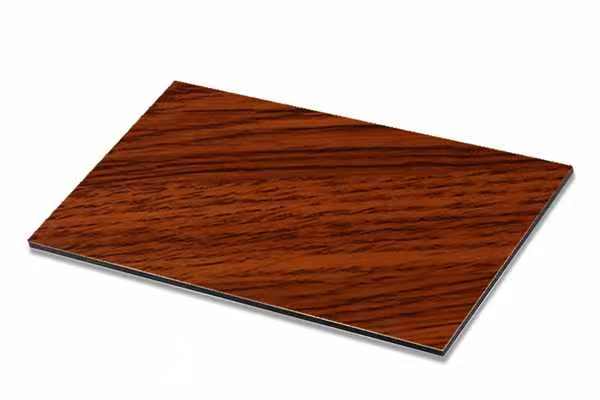
PE coating is softer. It stretches with the metal on a sharp fold. On a complex Alucobond wood grain finish detail, that flexibility can decide whether the fabrication succeeds or fails.
This guide explains where PE genuinely beats PVDF on complex geometry, where the advantage ends, and how procurement teams should separate interior feature work from exterior facade work on the same drawing set.
The Physics of a Bend and Why Rigid Films Crack
When a brake or a router fold bends a coated ACP panel, the metal on the outside of the curve stretches. A coating bonded to that metal must stretch with it. If the film cannot elongate enough, it fractures.
The strain demand rises as the bend radius tightens. A generous radius spreads the stretch over a long arc. A tight radius concentrates it in a narrow band. Coating formulators express this as elongation-at-break, and a film that cannot meet the imposed strain crazes or micro-cracks at the fold.
Crazing is not cosmetic. It is a structural failure of the film. Once the barrier breaks, moisture reaches the aluminum through a crack the inspector cannot see at the bench. The defect often stays invisible until UV, moisture, or thermal cycling opens it in service.
Where Standard PVDF Stops
PVDF’s weathering record is not in question. The limitation is mechanical, not environmental.
Standard PVDF is a rigid fluoropolymer. It performs on flat and gently curved surfaces because those geometries impose low strain. On a 90-degree brake-formed return, a 3 mm ACP panel can impose localized strain beyond what many standard PVDF formulations tolerate at the outer radius.
The gap sits inside the specification. AAMA 2605 qualifies coating systems on flat panels. The standard tests weathering, impact, and T-bend performance on stock geometry. When a project calls for a sub-2T bend radius—a return tighter than twice the panel thickness—the tested geometry and the fabricated geometry are no longer the same thing. A coating can satisfy AAMA 2605 completely and still crack on a tight return.【8-L22-L25】
For a plain colored panel, a fabricator can route the groove and control the radius to stay inside the coating’s limit. For an Alucobond wood grain finish, the decorative film adds another variable. The grain print sits in the coating system, and a crack at the fold line disrupts a pattern the eye reads as continuous. A hairline fracture on a solid color hides. On wood grain, it interrupts a visual line.
Where PE Flexibility Wins
PE (polyester) resin is softer and more ductile than standard PVDF. That softness translates directly into higher elongation on a tight fold.
Wood grain ACP built for complex fabrication uses a high-tenacity PE core and a ductile alloy to pass tight bend tests. Panels using AA3003-H14 alloy with a high-tenacity PE core have passed 0T–1T bend tests without microscopic fissures in the decorative timber coating—the range where standard rigid films struggle. Lower-quality wood grain panels crack at the bending line when forming U-grooves for corner transitions. The difference is the combination of alloy elongation, core elasticity, and film compliance.
The practical outcome for a fabricator: a PE-coated wood grain panel folds into a sharp cassette return, a deep reveal, or a multi-plane soffit without cracking at the bend line. The film moves with the metal. The grain pattern stays continuous around the corner.
That is a real fabrication advantage. On interior feature walls, reception desks, ceiling clouds, and column wraps where the geometry is tight and the climate load is low, PE flexibility does the job that rigid PVDF cannot.
Where the PE Advantage Ends
PE flexibility solves a forming problem. It does not solve a weathering problem.
PE coating breaks down under UV and moisture. Exterior PE finishes chalk and fade within 3 to 8 years, and the wood grain print fades with the resin that holds it. On a sun-exposed facade, the finish that looked crisp at handover turns powdery and washed-out within the first decade.
PVDF wood grain finishes carry the opposite trade-off. ALUCOBOND PLUS Woodgrain Series finishes meet AAMA 2605 standards, with color retention and chalk resistance tested for 10-year South Florida exposure. The film is built to hold its appearance outdoors for 20 years or more.
The choice therefore follows location, not preference.
Condition | Better coating choice | Why |
Interior feature wall, tight fold | PE wood grain | Flexibility prevents bend-line cracks |
Interior ceiling cloud, deep U-groove | PE wood grain | 0T–1T bend capability |
Sheltered exterior soffit, simple flat panels | PVDF wood grain | Appearance holds without UV load |
Exterior facade, any visible sun exposure | PVDF wood grain | AAMA 2605 color and chalk resistance |
Exterior facade with tight returns | PVDF with flexible formulation or radius redesign | Standard PVDF may crack; PE will fade |
Table 1. Coating selection by location and geometry. Interior and exterior wood grain ACP serve different loads and require different films.
The Exterior Wood Grain Problem Buyers Miss
An Alucobond wood grain finish specified for an exterior facade faces a double demand. The film must hold color under UV, and the print must survive the forming process without cracking.
Standard PVDF meets the first demand. On tight returns, it may not meet the second. A fabricator who forces a standard PVDF wood grain panel through a 1T fold creates a crack that the coating warranty may not cover, because the failure comes from fabrication geometry, not coating chemistry.
Two solutions exist for exterior wood grain on complex forms:
Flexible resin formulations. Some coating systems raise elongation-at-break without sacrificing AAMA 2605 weathering performance. These formulations are engineered to move with the metal on tight bends while holding color and chalk resistance outdoors. Specify the formulation by elongation data, not just the PVDF name.
Radius and groove design. Alucobond Legno panels can be folded into complex and multi-dimensional shapes using routing and folding. The key is to design the detail so the bend radius stays inside the coating’s rated limit. A fabricator who grooves to a deeper residual core tightens the radius; a fabricator who leaves more core keeps the radius generous and the film intact.
A buyer who specifies exterior wood grain without addressing bend radius has left the fabrication outcome to chance. The panel arrives, the fabricator folds it, and the crack appears after installation.
A Formability Checklist for Wood Grain ACP
Use this list before releasing a wood grain panel to fabrication.
Coating and finish
- For exterior use, confirm AAMA 2605 certification on the specific wood grain finish.
- For complex exterior forms, ask the coating supplier for elongation-at-break data or a flexible PVDF formulation rated for the required bend radius.
- For interior use, confirm the PE wood grain panel passes the 0T–1T bend test on the supplied alloy and core.
Panel construction
- Confirm the alloy grade. AA3003-H14 and similar high-elongation alloys outperform 1100-series on tight folds.
- Confirm the core type. High-tenacity PE core supports complex bending; brittle or low-density cores crack.
- Verify skin thickness on delivered panels. A thin skin concentrates strain at the fold.
Fabrication
- Specify the V-groove residual core thickness that produces the required bend radius. Do not route deeper than the coating’s rated limit.
- Require a bend test on a sample from the production batch before full fabrication.
- Keep the protective film on during rolling and folding to protect the wood grain print.
Bottom Line for Buyers
PE flexibility is the correct choice on complex interior forms. PVDF durability is the correct choice on any exterior surface that sees sun. The two requirements do not overlap on the same panel.
A Alucobond wood grain finish in PE folds into tight returns without cracking and serves interior feature walls, soffits, and ceiling elements. A wood grain finish in PVDF holds its print and color outdoors for decades, but standard rigid formulations crack on tight returns. On exterior complex forms, specify a flexible PVDF formulation or design the bend radius to stay inside the coating’s limit.
Match the coating to the location first. Then match the fabrication detail to the coating. The grain pattern follows both decisions.