Welcome to Vbond
Industrial ACP Cladding in High-Pollution Zones: Move Beyond PE

A PE-coated Alucobond panel saves money on the purchase order. In a high-pollution industrial zone, it costs far more than it saves. PE coating chalks, fades, and loses its protective film within a few years of exposure to acid rain, particulate, and chemical fallout. Once the film fails, the aluminum underneath faces the pollution alone.
The alternative is not complicated. A PVDF-coated Alucobond panel, with a brushed aluminum finish where the design calls for it, carries the chemical and UV resistance that industrial air demands. This guide explains why PE fails in polluted zones, how a brushed finish changes the maintenance equation, and what a procurement team should verify before approving a specification.
What High-Pollution Zones Actually Deliver
Industrial pollution is not one stressor. It is a mix that attacks a coating from several directions at once.
Acid rain. Sulfur dioxide and nitrogen oxides from stacks dissolve into rain and form dilute sulfuric and nitric acid. The film faces a low-pH wash after every storm.
Particulate soiling. Fly ash, cement dust, and metal particles settle on the facade. They hold moisture against the surface and bond into any chalked or porous film. Clean rain cannot rinse them away.
Chemical fallout. Ammonia from fertilizer production, fluoride from smelters, and chloride from certain processes add specific chemical attacks that a generic “weather-resistant” coating was never tested against.
UV plus pollution. UV breaks down organic resin. Heat and chemical pollutants accelerate that breakdown. A film that resists one load can still fail when all three hit the same surface.
PE coating loses on every path. PVDF is built to resist them together.
Why PE Is the Wrong Specification
PE coating is a polyester resin. Its polymer chain contains ester bonds. UV breaks those bonds. Acid rain hydrolyzes them. Both paths lead to the same result: the resin disintegrates and releases pigment as chalk.
The timeline is short. PE-coated panels exposed to sun, rain, and pollution show fading, chalking, and degradation within 5 to 7 years. Some supplier comparisons put PE color retention at 5–7 years against 25+ years for PVDF. In a polluted zone, the early end of that range is the norm because acid and particulate accelerate the breakdown.
The failure is not only cosmetic. Once PE chalks, the film no longer blocks moisture or pollution. The aluminum skin corrodes under the paint. Delamination at edges and joints follows. The panel needs replacement, and replacement repeats the access, labor, and disposal costs that dominate a facade budget.
PE carries no architectural rating for industrial polluted areas. Corrosion guidance from coating suppliers states the case plainly: PE offers ordinary corrosion resistance and is not ideal for coastal, acid rain, or industrial polluted areas. PVDF is the specification those environments require.
Why PVDF Holds Where PE Fails
PVDF is a fluoropolymer. Its backbone uses carbon–fluorine bonds. UV energy does not break that bond. Acid and alkali do not hydrolyze it the way they hydrolyze polyester.
A true architectural PVDF coating contains at least 70% Kynar 500 or Hylar 5000 resin. At that level, the coating meets AAMA 2605, the highest performance standard for architectural aluminum coatings. The standard requires 10-year South Florida outdoor exposure, 4,000-hour humidity, and 4,000-hour salt-spray testing.
PVDF performance in polluted air maps directly to the stressors:
Property | PE (Polyester) | 70% PVDF (AAMA 2605) |
Acid rain resistance | Poor; hydrolyzes | Strong |
Chemical fallout resistance | Low | High; resists acid, alkali, and chemicals |
Color retention in pollution | 5–7 years | 20–25+ years |
Chalking resistance | Fails within a few years | Anti-chalking; holds film |
Self-cleaning behavior | Low; dirt bonds to chalk | High density, low surface tension; dirt releases |
Surface hardness | Medium; scratches easily | Higher; abrasion and scratch resistant |
Table 1. Coating performance under industrial pollution. Data from coating supplier comparisons and AAMA 2605 performance requirements.
The table shows why PVDF is the safer specification. The film stays intact under the chemical load. The aluminum stays covered. The facade does not need a mid-life replacement.
The Brushed Aluminum Finish: A Different Maintenance Equation
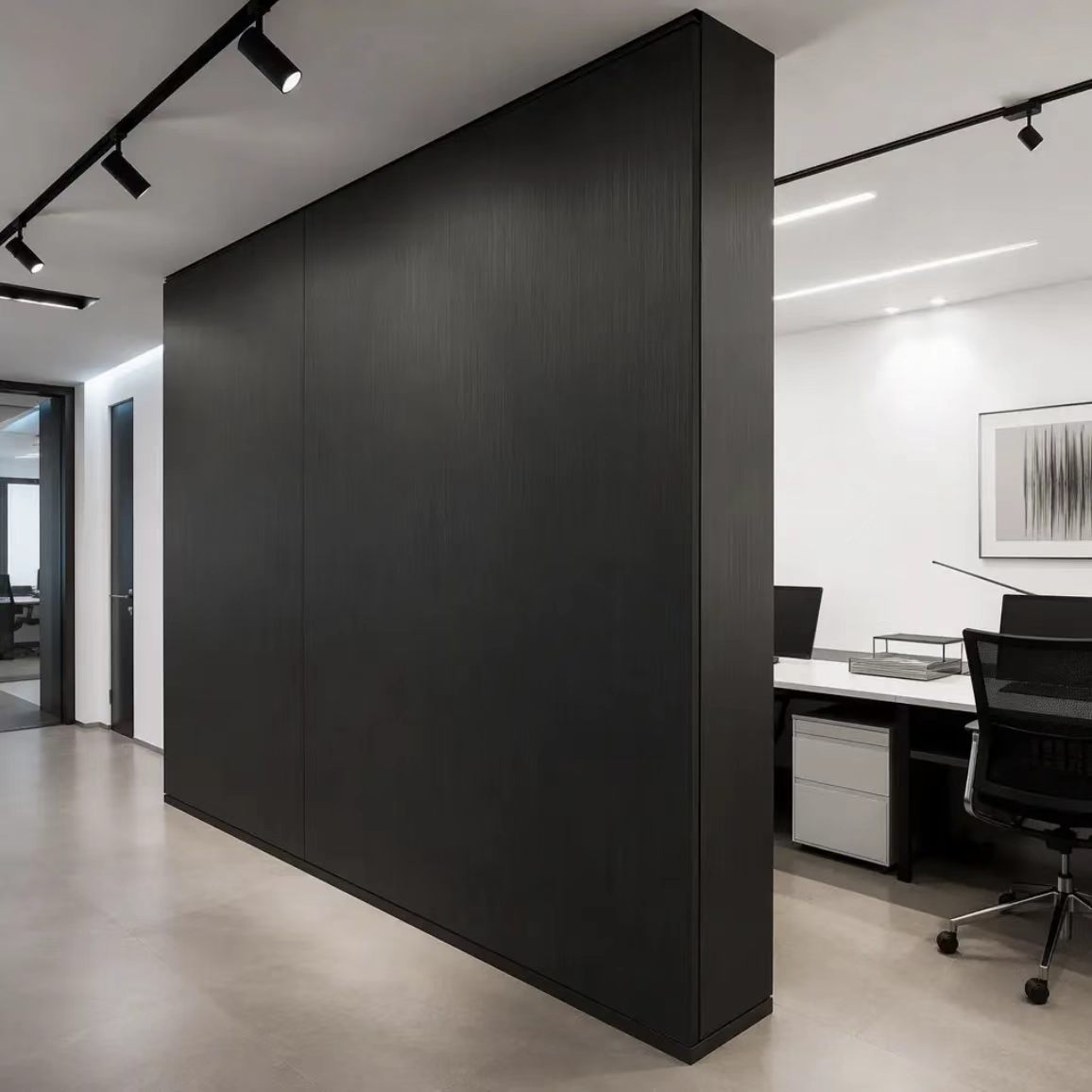
An Alucobond brushed aluminum finish adds a texture that changes how a facade interacts with pollution.
The brushing process creates a directional grain on the aluminum surface. That texture hides fingerprints, smudges, and minor scratches better than a smooth finish. The surface also carries a protective topcoat over the brushed layer. That topcoat delivers fingerprint resistance, easy cleaning, anti-corrosion performance, and high surface hardness for scratch resistance.
On a polluted industrial facade, the brushed texture provides two practical benefits:
It conceals what pollution leaves behind. A smooth panel shows every streak and stain. A brushed surface breaks up the visual line of a dirt streak. Minor soiling is less visible between wash cycles.
It resists the wear that cleaning causes. High-pollution facades need frequent washing. A smooth, softer surface abrades with repeated cleaning. A brushed finish with a hard topcoat holds its appearance through more cycles before the surface shows wear.
The finish does not replace the coating. A brushed surface in PE still chalks and fades. A brushed surface in PVDF holds its appearance and its film. The texture helps maintenance; the coating decides survival.
When Nano Self-Cleaning Changes the Math
Standard PVDF resists soiling and releases dirt better than PE. A nano self-cleaning topcoat goes further.
Nano coating adds a transparent nanostructured layer on top of the PVDF film. The layer is hydrophobic and anti-pollution. Rainwater forms droplets that roll off the surface and carry dust away. Streaking drops. Manual cleaning frequency falls.
For a high-rise industrial facade where access is expensive, nano self-cleaning can significantly lower long-term maintenance costs. The coating does not eliminate washing. It reduces how often the owner must mobilize access equipment to do it.
Specify nano as an option on PVDF, not as a substitute for PVDF. The fluoropolymer film provides the chemical and UV resistance. The nano layer provides the dirt release.
The Failure Chain PE Starts
The PE path in a polluted zone moves in one direction.
PE coating + industrial pollution
↓
Acid rain and UV break ester bonds
↓
Chalking begins within 5–7 years
↓
Film loses barrier; particulate bonds to chalk
↓
Moisture and chemicals reach the aluminum
↓
Corrosion under the film → delamination → replacement
Figure 1. PE degradation path in a high-pollution industrial zone.
PVDF interrupts the chain at the first step. The carbon–fluorine bond does not break under acid or UV. The film does not chalk. Particulate does not anchor. The aluminum stays covered through the coating’s 20-year warranty window.
A brushed finish helps the facade look cleaner between washes. It does not stop the chemical attack. Only the coating chemistry does that.
A Procurement Checklist for Polluted Industrial Zones
Use this list at submittal review for any ACP facade in a high-pollution zone.
Coating
- ≥70% Kynar 500 or Hylar 5000 resin, stated as a percentage on the coating maker’s data sheet.
- AAMA 2605 certification with 4,000-hour humidity and salt-spray reports.
- 20-year warranty covering chalk, color, and film adhesion. A 5-year PE warranty signals a coating that will fail inside the maintenance horizon.
- Nano self-cleaning topcoat as an option where access is expensive and cleaning frequency matters.
Brushed finish (where specified)
- Confirm the brushed texture sits under a protective topcoat, not bare brushed aluminum.
- Ask for pencil hardness (ASTM D3363) and abrasion cycle data on the topcoat. A minimum 2H hardness and 10,000 abrasion cycles are the practical thresholds for exterior durability.
- Confirm the finish is available in PVDF, not PE only. A brushed PE panel fades and chalks.
Panel and installation
- 0.5 mm AlMg1 (EN AW 5005A) skins on a 4 mm panel for corrosion resistance.
- 316 stainless fasteners at every connection.
- Written edge-sealing procedure for every cut face. Pollution finds open edges.
- Wash schedule in the O&M manual. Even PVDF needs periodic cleaning in a polluted zone.
Bottom Line for Buyers
PE coating is the wrong specification for a high-pollution industrial zone. It chalks and fades within 5–7 years under acid rain and chemical fallout. The film fails, the aluminum corrodes, and the owner pays for a replacement event that a PVDF panel would have avoided.
A PVDF-coated Alucobond panel with 70% Kynar or Hylar resin and AAMA 2605 certification carries the chemical resistance the environment requires. A brushed aluminum finish adds a texture that hides minor soiling and resists cleaning wear, but the finish does not replace the coating. Specify PVDF first, then choose the surface.
Add nano self-cleaning where access is costly. Add 316 fasteners and sealed edges to close the corrosion paths. The coating blocks the chemistry. The details block the corrosion. Together, they keep the facade in service through the pollution cycle.