Welcome to Vbond
How Missing Edge Ribs Turn Alucobond Facades Into "Drumheads"
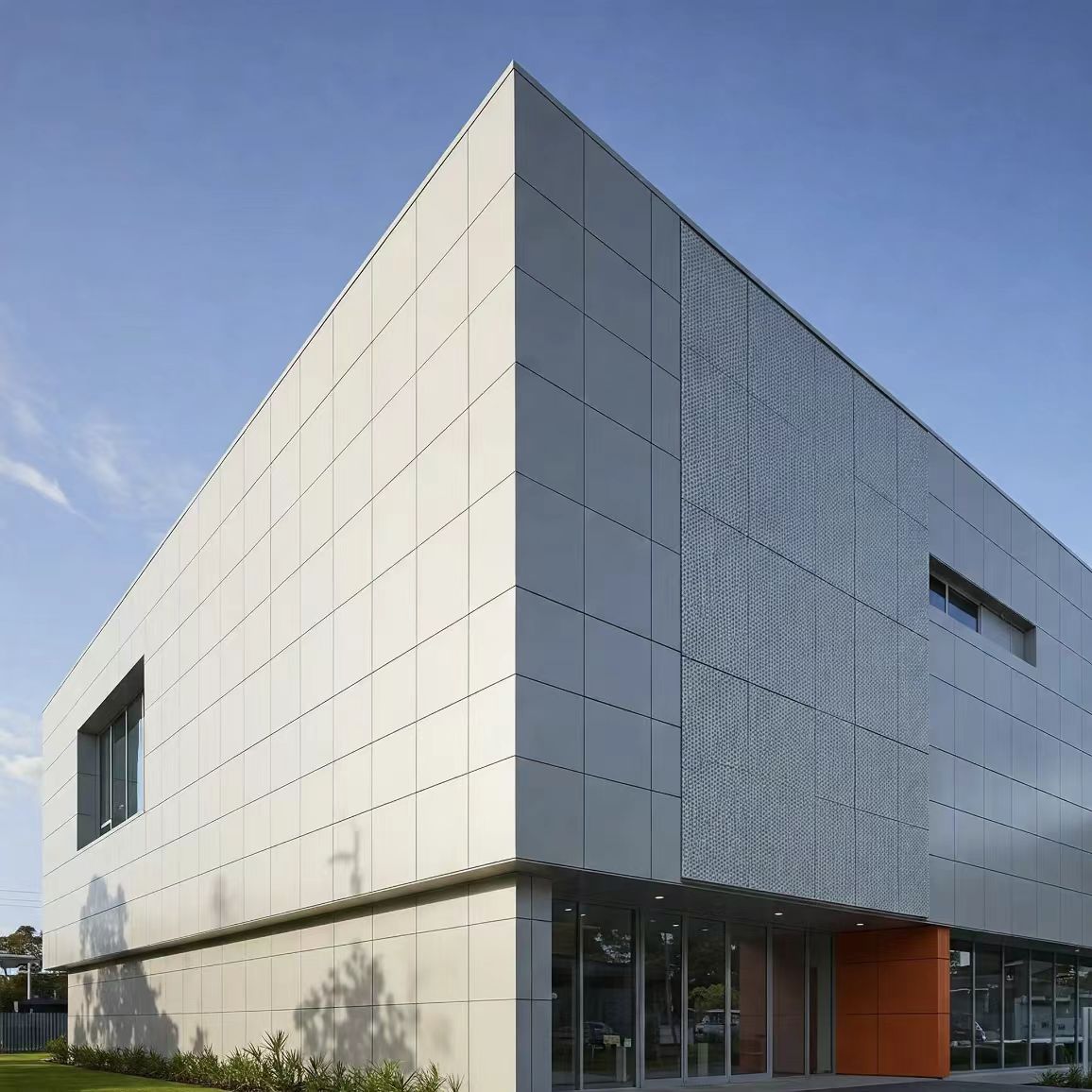
You stand in front of the completed building. The facade looks clean. The finish is flawless.
Then the wind picks up. You hear it. A low, hollow thumping sound. Like someone tapping a drum. You press your hand against the panel. It flexes. It vibrates. It moves.
The facade is not a wall. It is a drumhead. And someone forgot to give it structure.
This guide explains why missing edge ribs turn Alucobond facades into drumheads. You will learn what edge ribs do. You will understand the physics behind the failure. And you will know exactly how to specify and install proper edge reinforcement.
Part 1: What Is an Edge Rib?
An edge rib is the folded edge that runs along the perimeter of an Alucobond panel. The fabricator routes a V-groove on the back side and folds the edge upward at a 90-degree angle, creating a stiffened rim around the panel.
The official standard:
Chinese technical standard JGJ 255-2012 specifies that "single-layer metal panels and aluminum-plastic composite panels should have folded edges or edge ribs around the perimeter; the fold height should not be less than 20mm". The standard further requires that "aluminum-plastic composite panels should have edge ribs at the folded edges".
Edge ribs are not decorative. They are structural.
Part 2: The Physics of a Drumhead
A drumhead is a thin membrane stretched over a circular frame. It vibrates when struck. It flexes under pressure. It has no inherent stiffness of its own—only tension.
A flat Alucobond panel without edge ribs behaves the same way.
A 4mm Alucobond panel has impressive rigidity for its weight. The standard 4mm panel delivers a flexural rigidity (E·J) of 2,400 kNcm²/m. But that rigidity comes from the sandwich structure—two thin aluminum skins bonded to a core.
Without edge ribs, the panel relies entirely on its flat sandwich structure for stiffness. The panel flexes under wind pressure. It vibrates under gust loads. It behaves as a drumhead stretched over a frame, with no structural backbone to keep it flat.
What a drumhead does:
- It flexes when pressure is applied
- It vibrates when struck
- It returns to its original shape—until it doesn't
- It transfers all stress to its perimeter connections
What a panel without edge ribs does:
- Flexes under wind load
- Vibrates under gust conditions
- Transfers all stress to the fasteners at the perimeter
- Buckles when the stress exceeds the aluminum's capacity
The result is visible deformation, hollow sounds, and eventual failure.
Part 3: What Edge Ribs Actually Do
Edge ribs transform a flat panel into a box-like structure. The folded edge creates an "I-beam" effect, dramatically increasing the panel's resistance to bending and deflection.
The structural benefits:
- Increased stiffness — The folded edge adds rigidity without adding much weight
- Load distribution — Edge ribs distribute wind and thermal loads across the entire panel perimeter
- Stress reduction — They prevent stress concentration at fastener points
- Moisture barrier — Folded edges protect the exposed core from moisture ingress
What the standards require:
"Aluminum-plastic composite panels should have edge ribs at the folded edges". The edge ribs must be securely connected to the panel and have anti-corrosion measures.
For larger panels, mid-ribs are also required. "Metal panels should have edge ribs and middle ribs as needed". The middle ribs should have sufficient stiffness, and their deflection should not exceed 1/300 of the rib span.
Part 4: What Happens When Edge Ribs Are Missing
When a fabricator skips the edge ribs to save time or material, the panel loses its structural backbone. The results are predictable—and destructive.
Consequence 1: The drumhead effect
Without edge ribs, the panel flexes under wind pressure like a drumhead. It vibrates. It makes a hollow sound when tapped. The panel behaves like a thin membrane, not a rigid structural element.
Consequence 2: Wind-induced deformation
As one industry analysis puts it: "panels without edge ribs and middle ribs deform under wind pressure and air expansion". This "bulging" phenomenon commonly appears on curtain walls using aluminum composite panels. Some manufacturers save costs by omitting the edge ribs and simply screwing the flat panel to the frame. The panel lacks sufficient strength and deforms under positive and negative wind pressure.
Consequence 3: Stress concentration at fasteners
Without edge ribs, the panel transfers all stress to the fasteners. The fasteners pull against the thin aluminum skin. The skin tears. The panel fails.
Consequence 4: Blistering and delamination
The repeated flexing stresses the adhesive bond between the aluminum skins and the core. The bond fails. Voids form. Those voids become visible blisters.
Consequence 5: The hollow sound
When you tap a panel without edge ribs, the sound is hollow. The panel is not rigidly supported. It vibrates like a drumhead. When you tap a panel with proper edge ribs, the sound is solid. The panel is stiff. It does not vibrate.
Part 5: The Numbers — What Proper Edge Ribs Look Like
From JGJ 255-2012:
Requirement | Specification |
Fold height | Not less than 20mm |
Edge rib requirement | "Aluminum-plastic composite panels should have edge ribs at the folded edges" |
Mid-rib deflection | Not more than 1/300 of the rib span |
Rib section thickness | Not less than 1.5mm |
Rib material | Metal square tube, channel, or angle profile |
From ALUCOBOND fixing stiffeners guidelines:
"Position the stiffener rib and keep a 2mm gap between the folded edges".
From industry practice:
"To strengthen the border or middle rib use an aluminum alloy square tube, groove or corner profile. Strengthen the border or middle ribs should be reliably linked with the panel and should have anti-corrosion measures".
Part 6: How to Specify Proper Edge Ribs
What to include in your procurement documents:
1. Edge ribs required — "All panels shall have folded edges (edge ribs) around the entire perimeter. Fold height shall be no less than 20mm."
2. Mid-ribs for large panels — "Panels exceeding 900mm in width shall have mid-ribs installed on the back surface."
3. Rib material — "Mid-ribs shall be metal square tubes, channel sections, or angle profiles with section thickness not less than 1.5mm."
4. Deflection limit — "Mid-rib deflection shall not exceed 1/300 of the rib span under design wind load."
5. Connection requirements — "Mid-ribs shall be securely connected to edge ribs. Connections shall meet force transmission requirements."
6. Corrosion protection — "All ribs shall have corrosion protection appropriate for the environment."
Part 7: The Consequences of Skipping Edge Ribs — A Summary
Consequence | What Happens | Why It Matters |
Drumhead effect | Panel flexes and vibrates under wind load | Visible movement, hollow sounds, client complaints |
Wind deformation | Panel bulges under positive and negative pressure | Panel bulges under positive and negative pressure |
Fastener stress | All load transfers to perimeter fasteners | Fastener pull-through, panel detachment |
Blistering | Repeated flexing breaks adhesive bond | Surface defects, panel failure |
Void formation | Aluminum skin separates from core | Structural compromise, replacement required |
What to Ask Your Supplier
When you purchase a 4mm Alucobond panel for your project, ask these questions:
1. Do you include edge ribs in your panel fabrication? The answer should be yes. Every panel for exterior use needs folded edges.
2. What is your fold height?** The answer should be no less than 20mm.
3. Do you use mid-ribs for large panels? For panels over a certain size, mid-ribs are required.
4. What is your mid-rib section thickness? The answer should be no less than 1.5mm.
5. How do you connect mid-ribs to edge ribs? Connections must meet force transmission requirements.
6. Can you provide examples of proper edge folding? A reputable supplier should be able to show you fabricated samples.
The Bottom Line
A 4mm Alucobond panel without edge ribs is a drumhead. It flexes. It vibrates. It makes hollow sounds when tapped. It deforms under wind pressure. It transfers all stress to its fasteners. It blisters. It fails.
A 4mm Alucobond panel with proper edge ribs is a structural element. It resists bending. It distributes loads. It stays flat. It sounds solid when tapped. It lasts for decades.
The difference is not visible from the outside. Both panels look the same on the surface. But one has a structural backbone. The other is a membrane waiting to fail.
The standards are clear: "Aluminum-plastic composite panels should have edge ribs at the folded edges". Fold height should not be less than 20mm. Mid-ribs should have sufficient stiffness, and deflection should not exceed 1/300 of the rib span. Rib section thickness should not be less than 1.5mm.
When you stand in front of that building two years from now, pressing your hand against a solid, flat 4mm Alucobond panel that doesn't flex, doesn't vibrate, and doesn't sound hollow, you will know—not hope, not guess, but know—that the edge ribs are there. Because you specified them. Because you refused to let a fabricator skip the most important structural detail. Because you understood that a facade is not a drumhead.
Specify the edge ribs. Protect your facade. Protect your reputation.