Welcome to Vbond
How to Avoid Aluminum Composite Panel Shortages Caused by Fabrication Errors
How to Avoid Aluminum Composite Panel Shortages Caused by Fabrication Errors
Your project is on track. The aluminum composite panels have arrived. The fabrication shop begins cutting, routing, and folding. Then disaster strikes: panels crack during bending, edges delaminate, or dimensions are incorrect. Suddenly, you are short of usable panels—and the supplier cannot deliver replacements before your deadline.
Fabrication errors are a leading cause of aluminum composite panel shortages, yet they are often the most preventable. When a professional aluminum composite panel manufacturer provides clear processing guidelines and when fabricators follow industry best practices, waste is minimized. However, when fabrication processes are rushed, improperly executed, or based on incorrect assumptions, otherwise perfect panels become unusable scrap.
This guide analyzes the most common fabrication errors that create panel shortages, provides the processing parameters that every fabricator must follow, and explains how procurement professionals can structure contracts and quality controls to avoid these costly mistakes.
1. How Fabrication Errors Create Shortages
Fabrication errors do not merely damage individual panels—they create cascading shortages that disrupt entire projects.
Error Type | Shortage Impact | Why It Creates Shortages |
Cracking during bending | 10-30% of panels scrapped | Minimum bend radius exceeded; grain direction ignored |
Edge delamination | 5-15% of panels scrapped | Router speed too high; dull cutting tools |
Dimensional inaccuracy | 5-20% of panels scrapped | Incorrect CNC programming; material movement |
Surface damage | 5-10% of panels scrapped | Protective film removed too early; handling errors |
Core exposure | Batch rejection | Groove depth incorrect; aluminum skin penetrated |
Even a 10% fabrication error rate on a 5,000m² order creates a shortage of 500m²—often more than a week of production time for the manufacturer to replace, assuming raw material is even available. The result is project delay, idle labor, and expensive expedited shipping.
As one industry expert notes: "Cutting corners on fabrication is like building a house on sand—the foundation may look fine, but the first stress reveals the weakness."
2. The Aluminum Composite Panel Material: What Fabricators Must Understand
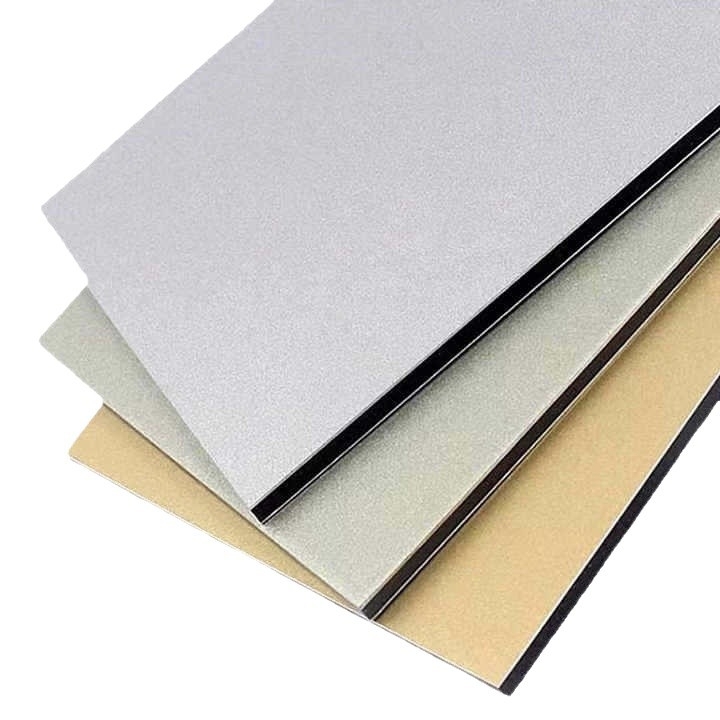
Before any fabrication begins, fabricators must understand that aluminum composite panels are not solid metal—they are sandwich structures with unique processing requirements.
The Three Layers
Layer | Material | Thickness (Typical) | Behavior During Fabrication |
Top aluminum skin | AA3003 or AA5005 alloy | 0.15-0.50mm | Soft, can tear if over-stressed |
Core | PE, FR, or A2 mineral | 3.0-3.6mm (for 4mm panel) | Can crush, melt, or delaminate |
Bottom aluminum skin | Same as top | 0.15-0.50mm | Same as top |
The core behaves differently from the aluminum skins. When fabricators apply techniques designed for solid aluminum, they often damage the core or cause delamination.
A reputable aluminum composite panel manufacturer provides detailed processing manuals. The ALUCOBOND processing guide specifies that "V-shaped or rectangular grooves are routed on the rear of the panels using disk or end milling cutters, whereby the aluminium cover sheet at the front and part of the polyethylene core are retained". The critical point: the front aluminum skin must remain intact—cutting through it creates a failed panel.
Similarly, an Alucobond factory processing manual states: "The small thickness of the remaining material then allows folding by hand. A brake press is not required. The groove shape determines the bend radius".
The same manual warns: "With ALUCOBOND with anodised surface and ALUCOBOND with naturAL Reflect surface, the formation of micro-cracks leads to brightening in the edges". This means that certain surface finishes require even more careful processing.
3. Common Fabrication Errors and Their Prevention
Error 1: Exceeding Minimum Bend Radius
The Problem: When the bending radius is too tight, the aluminum skin cracks, or the core wrinkles. This creates visible defects and structural weakness.
Research on curved aluminum composite panel construction identifies "cold bending cracking/wrinkling" as the most common forming problem. The critical parameters are:
Panel Thickness | Minimum Bend Radius (R) | Consequence if Exceeded |
3mm | ≥60mm | Cracking or wrinkling |
4mm | ≥80mm | Core crushing; skin fracture |
The Solution: Implement layered gradual bending. The recommended process uses a three-roll plate bending machine with progressive pressure: 0.5MPa → 0.8MPa → 1.2MPa, with each bending angle ≤15° and stress relief every 2 hours.
For sharp bends with a radius below 50mm, use a 3mm thin plate with a backing aluminum plate for reinforcement.
Impact on Shortages: Studies indicate that following these parameters can reduce the installation defect rate from 35% to below 5%.
Error 2: Incorrect Groove Depth in Routing and Folding
The Problem: In the routing and folding technique, a V-shaped or rectangular groove is cut on the rear side. If the groove is too shallow, folding is difficult or impossible. If too deep, the front aluminum skin is compromised, and the panel fails.
The Solution: ALUCOBOND® processing guidelines specify that the remaining material thickness after routing determines the fold quality. The groove must retain the front aluminum cover sheet and part of the core—but not penetrate to the decorative surface.
For edges up to 90°, a V-shaped groove with approximately 3mm radius is used. For edges up to 135°, a wider V-groove accommodates the greater angle.
Critical Rule: Before scaled production, testing on sample panels is mandatory when using new tooling or materials.
Error 3: Improper Bending Direction and Grain Orientation
The Problem: Aluminum composite panels have directional properties based on the core fiber orientation and coil rolling direction. Bending perpendicular to the fiber direction increases cracking risk.
The Solution: The ALUCOBOND® processing guide emphasizes that bending must be performed perpendicular to the core fiber direction.
When using brake presses, the air-bending process is preferred. The die edges must be rounded and smooth. The ideal die width formula is: 2 x panel thickness + 2 x protective film thickness + punch diameter + 15mm.
Error 4: Contamination from Other Metals
The Problem: Bending rollers and tooling used for steel or other metals transfer debris that embeds in the soft aluminum surface, causing scratches and coating damage.
The Solution: The ALUCOBOND processing manual explicitly states: "Bending rollers, which are also used for bending other metals, must be thoroughly cleaned from swarf before processing ALUCOBOND®. We recommend ground rollers to avoid damaging the cover sheets".
The same principle applies to saw blades, router bits, and folding machines. Dedicated tooling for aluminum composite panels is a best practice.
Error 5: Premature Protective Film Removal
The Problem: The protective film is designed to remain in place during fabrication—cutting, routing, bending, and handling. Removing it prematurely exposes the decorative surface to scratches, adhesive transfer from tooling, and environmental contamination.
The Solution: ALUCOBOND processing guidelines are explicit: "To prevent damage caused to the panel surface, the protective peel-off foil must not be removed during bending".
The film should only be removed after final installation, when cleaning and finishing are complete. For additional protection during bending, the manual recommends using plastic pads of 1-2mm thickness on contact surfaces.
Error 6: Incorrect Tooling and Feeder Pressure
The Problem: Excessive feeder pressure during roll bending can cause permanent deformation, core crushing, or surface marking.
The Solution: The ALUCOBOND processing guide warns: "Make sure that the feeder does not exert too much pressure".
For roll-bending machines (three or four-roll systems), the following precautions apply:
- Use only polished rollers free of dents and defects
- Set pressure to the minimum required for consistent bending
- Test on sample panels before production runs
4. Rebound Deformation: The Hidden Fabrication Variable
One of the most frequently overlooked fabrication errors is failing to account for springback—the tendency of the panel to partially return to its original flat shape after bending.
Curved panel construction research identifies rebound deformation as a major quality issue: "Phenomenon: The arc surface rebounds and becomes straight after installation".
The Cause: The aluminum skins have elastic memory. After bending, they try to return to their original flat state. This is quantified as a rebound angle of approximately 3-5°.
The Solution: Calculate the rebound amount and over-bend by 5-8% during processing. For example, if the design curvature is 30°, it actually bends to 31.5-32.4°.
For critical curved applications, use a three-dimensional adjustable keel system with plane angle adjustment of ±15° and radial displacement of ±20mm to accommodate any remaining springback.
5. Environmental Factors Affecting Fabrication
Fabrication errors are not always the fabricator's fault. Environmental conditions significantly affect how aluminum composite panels behave during processing.
High Temperature and Humidity
In tropical markets, high temperature and humidity cause:
- Core material expansion (PE core volume increases by 1.5% at >70°C)
- Adhesive softening during routing
- Increased material flexibility (changes bending behavior)
Solution: Fabricate in climate-controlled facilities when possible. Adjust tooling parameters for ambient conditions.
Cold Temperature
At low temperatures (below 10°C), the core becomes more brittle, and the coating is more prone to cracking during bending.
Solution: Allow panels to acclimate to the fabrication facility temperature for 24-48 hours before processing. Avoid fabrication in unheated spaces during winter.
6. Quality Control Measures to Prevent Shortages
Before Fabrication: Material Validation
Check | Method | Pass Criteria |
Panel thickness | Digital caliper | Within ±0.10-0.15mm of specification |
Coating adhesion | Cross-hatch tape test (ASTM D3359) | Rating 4B or 5B |
Core type verification | Burn test on scrap | Matches specification (A2, FR, or PE) |
Surface condition | Visual inspection under good lighting | No pre-existing scratches or defects |
A professional aluminum composite panel manufacturer will provide batch-specific documentation, including peel strength test results (minimum 50 N/mm) and coating thickness verification (typically 25-30μm for PVDF).
During Fabrication: Process Controls
Control Point | Check | Frequency |
Router bit sharpness | Edge quality inspection | Every 50-100 panels |
Groove depth | Micrometer measurement | First panel of each batch; then every 25 panels |
Groove depth | Micrometer measurement | First panel of each batch; then every 25 panels |
Bending angle | Protractor or digital angle gauge | First panel of each batch; then every 50 panels |
Surface protection | Protective film integrity | Continuous visual |
Post-Fabrication: Finished Panel Inspection
- Visual inspection of all panels for cracks, scratches, or edge damage
- Dimensional verification against shop drawings (±1mm tolerance typical)
- Test folding on scrap pieces when changing materials or tooling
7. Contractual Protections Against Fabrication Shortages
Procurement professionals can structure contracts to minimize shortage risk.
Specify Fabrication Requirements in the Purchase Order
"Fabricator shall comply with manufacturer's processing guidelines, including minimum bend radius (60mm for 3mm panels, 80mm for 4mm panels), protective film retention during all fabrication steps, and tooling dedicated to aluminum composite panels. Fabricator shall perform sample testing before production runs and maintain quality control records."
Require Fabricator Qualifications
Before awarding a fabrication contract, verify:
- Experience with aluminum composite panels (not just sheet metal)
- Access to manufacturer processing manuals
- Tooling in good condition (sharp router bits, polished rollers)
- Quality control procedures and documentation
Establish Material Contingency
Include in the contract:
"Buyer shall order [15%] additional panel quantity as fabrication contingency. Unused contingency panels may be returned at the Buyer's expense. Fabricator shall notify Buyer immediately if error rate exceeds [5%] so additional material can be ordered before shortage occurs."
Define Acceptance Criteria
Defect | Acceptance | Action if Exceeded |
Minor edge burrs | Acceptable | Deburring required |
Visible surface scratches | Not acceptable | Panel rejected |
Core exposure at the cut edge | Not acceptable | Panel rejected |
Cracking at the bend | Not acceptable | Panel rejected |
Dimensional error <2mm | Acceptable | None |
Dimensional error >2mm | Not acceptable | Panel rejected; re-fabrication required |
8. The Role of the Aluminum Composite Panel Manufacturer
A quality aluminum composite panel manufacturer supports shortage prevention in several ways.
Providing Processing Guidelines
Professional manufacturers provide detailed processing manuals. ALUCOBOND publishes comprehensive "Processing and Technical Data" guides covering routing, folding, bending, and joining techniques. These documents specify tooling requirements, pressure settings, and quality checkpoints.
Offering Technical Support
Many manufacturers provide direct technical support to fabricators, including:
- On-site training for new fabricators
- Troubleshooting assistance when problems arise
- Sample testing verification
Maintaining Consistent Product
When an aluminum composite panel manufacturer maintains tight production tolerances, fabricators can rely on consistent material behavior. Variation in core density, skin thickness, or coating properties forces fabricators to constantly adjust, increasing error rates.
Vertically integrated operations with in-house coating lines achieve better consistency than fragmented supply chains. As one manufacturer highlights, their in-house R&D unit and more than 100 testing pieces of equipment ensure product quality meets international standards before panels leave the factory.
9. When Shortages Occur: Mitigation Strategies
Despite best efforts, shortages may occur. Have a response plan.
Immediate Actions
1. Quantify the shortage – How many panels are needed? How soon?
2. Identify the cause – Is it a specific fabrication error or material defect?
3. Allocate remaining usable panels – Prioritize visible vs. hidden areas
4. Contact the supplier immediately – Request expedited production of additional panels
Root Cause Analysis
If fabrication errors caused the shortage:
- Review processing parameters against manufacturer guidelines
- Inspect tooling for wear or damage
- Check material certification against delivered panels (potential substitution?)
If material defects caused the shortage:
- Preserve samples for laboratory testing
- Notify the manufacturer of a warranty claim
- Request replacement material at the manufacturer's expense
Contingency Sourcing
For time-critical shortages, consider:
- Local stockists who may have matching material
- Alternative fabricators with available capacity
- Design modifications to use remaining panels differently
10. Conclusion
Fabrication errors are a leading cause of aluminum composite panel shortages, yet they are largely preventable. By understanding the material's unique properties, following manufacturer processing guidelines, implementing quality controls, and building contingency into contracts, procurement professionals can dramatically reduce shortage risk.
The core principles for avoiding fabrication-related shortages are:
1. Know the material – ACPs are sandwich structures, not solid metal
2. Follow manufacturer guidelines – Bend radii, groove depths, and tooling requirements are specified for a reason
3. Protect the surface– Keep protective film on until final installation
4. Test before production – Verify parameters on sample panels
5. Monitor continuously – Inspect during fabrication, not just at the end
6. Build contingency– Order 15% extra material for complex fabrications
7. Choose qualified fabricators – Experience with ACPs matters
Whether you are sourcing from a specialized aluminum composite panel manufacturer or a global Alucobond factory, the same principles apply: proper processing prevents shortages. The cost of re-fabrication, expedited shipping, and project delay far exceeds the cost of careful quality control.
In aluminum composite panel fabrication, measure twice, cut once—and test before you fold.