Welcome to Vbond
How to Design Edge Frames That Absorb Thermal Stress Without Deforming Alucobond
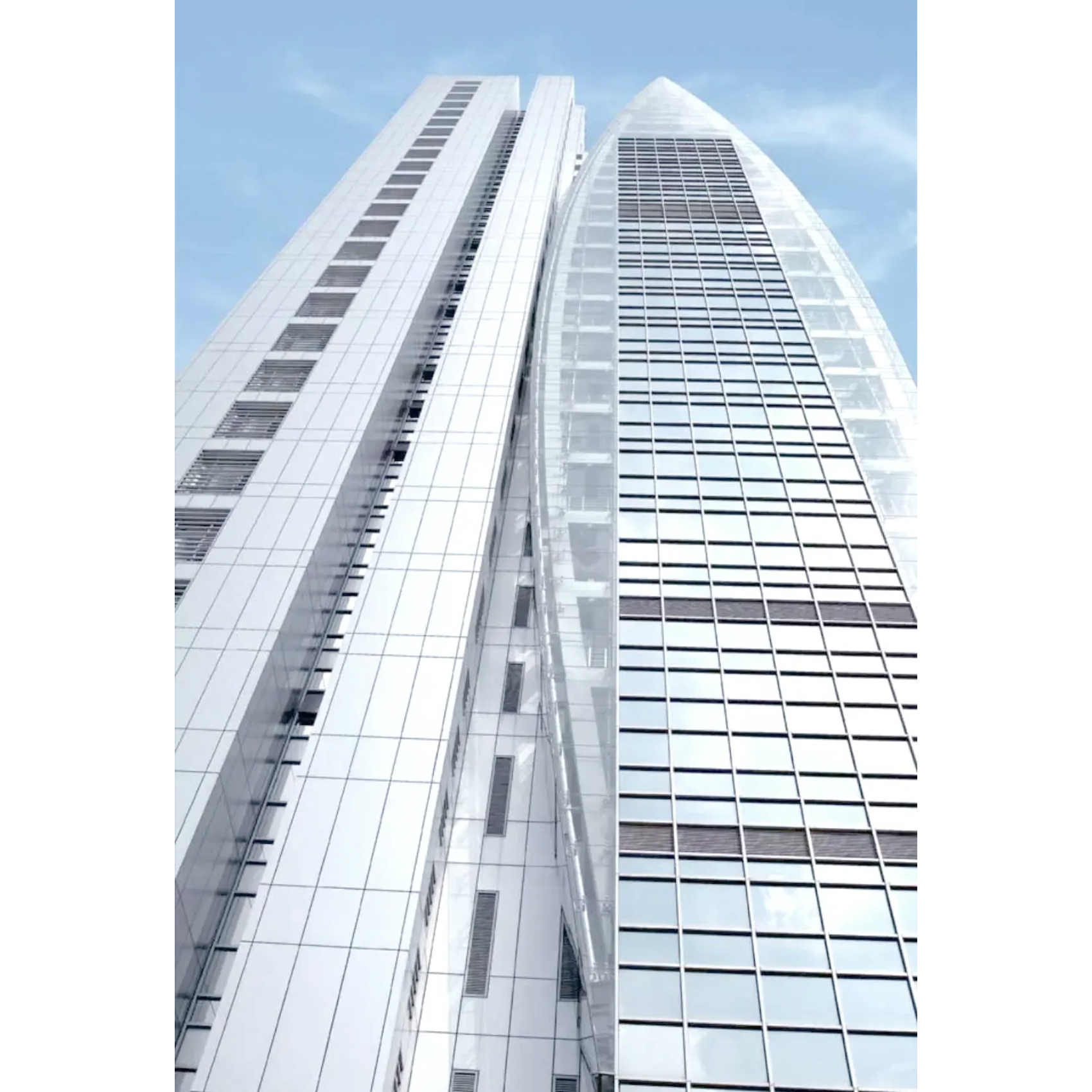
You specify a beautiful Alucobond facade. The panels are flat. The finish is flawless. The installation looks perfect.
Then summer arrives. The sun hits the building. You see them. Buckling. Ripples. Distortion along the panel edges. The sleek facade now looks damaged.
The problem is not the panel. The problem is the edge frame. It does not allow the panel to move. Thermal stress has nowhere to go. The panel deforms.
This guide explains how to design edge frames that absorb thermal stress without deforming Alucobond. You will learn the physics behind thermal movement. You will understand the fixed-point/sliding-point principle. And you will know exactly how to design frames that keep panels flat.
Part 1: The Physics of Thermal Stress
Alucobond expands and contracts with temperature changes. The linear thermal expansion coefficient is 2.4 mm per meter for every 100°C temperature difference.
In plain English:
A 1-meter-long Alucobond sheet expands by 2.4 mm when its temperature rises by 100°C. A 3-meter sheet expands by 3.6 mm. A 4-meter sheet expands by 4.8 mm.
For a real-world example:
Take a 3-meter panel. Expected heating of the panel is approximately 70°C (measured on a black panel at an air temperature of 40°C). With an assembly temperature of 20°C, the temperature difference is 50°C. Total expansion: 3.6 mm.
A 4-meter panel in a 60°C temperature swing expands by nearly 6 mm.
The core makes it worse.
The aluminum skins expand at the standard rate. But the polyethylene core expands at approximately 1.5×10⁻⁴/°C—nearly six times more than the aluminum. This mismatch creates internal stress. The core wants to expand more than the skins allow. That stress concentrates at the bond line.
What this means for your edge frame:
If the edge frame does not allow for this movement, the panel cannot expand. Stress builds. The panel buckles, oil-cans, or deforms. The frame must absorb the stress without transferring it to the panel.
Part 2: The Problem with Rigid Frames
A rigid edge frame locks the panel in place. Every fixing point is fixed. The panel cannot move. The stress has nowhere to go.
What happens with a rigid frame:
1. The sun heats the panel. The aluminum expands. The core expands even faster.
2. The rigid frame prevents the panel from expanding outward.
3. Stress builds inside the panel.
4. The panel has two choices: stretch beyond its limit, or buckle.
5. The panel buckles. Waves and ripples appear.
6. The adhesive bond between skin and core is stressed. Blisters form.
The official ALUCOBOND warning:
"To avoid any tension occurring in the rivet and screw connections, the rivets and screws must be set tension-free. The bore holes in the panels must be large enough to allow for the expected thermal expansion".
A rigid frame violates this principle. It creates tension. It locks the panel in place. It causes deformation.
Part 3: The Fixed-Point/Sliding-Point Principle
The solution is simple: one fixed point, all other points sliding.
How it works:
- Each panel has one "dead fix" (fixed point), usually positioned centrally
- All other fixings feature oversized or slotted holes
- The panel can expand and contract freely in every direction from the fixed point
- Stress does not build up. The panel stays flat.
The fixed point:
The fixed point anchors the panel. It is the only point where the panel is locked in place. All expansion and contraction occurs outward from this point.
The sliding points:
All other attachments are sliding. They use oversized holes or slotted holes. The panel can slide freely as it expands and contracts. No stress builds. No deformation occurs.
The hole size rule:
"With the shaft of the rivet fitting closely to the edge of the hole, the attachment head must cover over 1 mm of the area surrounding the hole".
Component | Requirement |
Hole in the panel | Larger than the fastener shaft |
Attachment head | Covers at least 1 mm beyond the hole edge |
Rivet shaft | Fits closely to the hole edge |
Drilling method | Centrally drilled using multi-step drills or sleeves |
The edge frame must be designed to accommodate the expected thermal movement. This means providing adequate space for the panel to expand and contract.
Rule 1: Allow for movement in all directions
The panel expands in every direction from the fixed point. The frame must allow movement in all directions—horizontal, vertical, and diagonal.
Rule 2: Size the expansion gaps correctly
The minimum gap depends on the expected expansion of the panel.
Calculation:
Expansion (mm) = 2.4 × L (meters) × (ΔT ÷ 100)
Panel Length | Temperature Difference | Total Expansion | Gap Per Edge |
2 meters | 50°C | 2.4 mm | 1.2 mm |
3 meters | 50°C | 3.6 mm | 1.8 mm |
4 meters | 50°C | 4.8 mm | 2.4 mm |
6 meters | 50°C | 7.2 mm | 3.6 mm |
Rule 3: Use appropriate fixing hardware
"Rivet attachment jigs are used for fitting blind rivets without jamming, allowing for a tolerance of 0.3 mm".
Rule 4: Arrange substructure joints at panel joints
"Arrange the butt joints of the supporting sections at the panel joints to avoid jamming due to opposing thermal expansion".
Part 5: 3mm vs. 4mm — Thermal Movement Considerations
A 3mm Alucobond sheet has less thickness than a 4mm Alucobond sheet. Less thickness means less rigidity. Less rigidity means the panel is more susceptible to deformation from thermal stress.
Factor | 3mm Sheet | 4mm Sheet |
Flexural rigidity | Lower (1,250 kNcm²/m) | Higher (2,400 kNcm²/m) |
Relative stiffness | 48% less stiff* | Baseline |
Thermal expansion rate | Same (2.4 mm/m/100°C) | Same (2.4 mm/m/100°C) |
Susceptibility to deformation | Higher | Lower |
Frame design requirement | More critical | Standard |
What this means for frame design:
Both 3mm and 4mm panels expand at the same rate. The difference is how much stress they can absorb before deforming. A 3mm Alucobond sheet is more vulnerable to deformation from thermal stress because it is less rigid. The edge frame must be designed with even more attention to movement allowance.
For a 3mm panel in a high-temperature swing, the frame must allow for the same expansion as a 4mm panel—but the panel will deform more easily if the frame restricts movement. The sliding points must be more generous. The expansion gaps must be adequate. The fixed point must be precisely positioned.
Part 6: The Thermal Stress Absorption Flowchart
Start
│
▼
Determine expected thermal expansion
│
├─── ΔL = 2.4 × L × (ΔT ÷ 100)
│
▼
Design frame with one fixed point per panel
│
├─── Positioned centrally
├─── Anchors the panel
└─── All expansion occurs outward from this point
│
▼
Design all other fixings as sliding points
│
├─── Oversized holes (1mm head coverage minimum)
├─── Slotted holes
└─── Rivet attachment jigs (0.3mm tolerance)
│
▼
Size expansion gaps
│
├─── Gap per edge = half of total expansion
├─── Minimum 8- 12 mm for standard panels
└─── Expansion joints for runs exceeding 6m
│
▼
Arrange substructure joints at panel joints
│
├─── Avoid opposing thermal expansion
└─── Prevent jamming
│
▼
Install with tension-free connections
│
├─── Do not over-tighten fasteners
└─── Maintain 0.3mm distance between panel and rivet head
│
▼
DONE ───► Panel can expand freely. No deformation.
Part 7: Common Mistakes to Avoid
Mistake 1: Using multiple fixed points
Multiple fixed points lock the panel in place at multiple locations. The panel cannot expand. It buckles.
Fix: Use exactly one fixed point per panel. All other fixings must be sliding.
Mistake 2: Over-tightening fasteners
Over-tightening locks the panel in place. The panel cannot slide. Stress builds. The panel deforms.
Fix: Set fasteners tension-free. Use rivet attachment jigs to maintain 0.3mm tolerance.
Mistake 3: Using undersized holes
Standard holes do not allow movement. The fastener shaft fills the hole. The panel cannot slide.
Fix: Use oversized or slotted holes. The attachment head must cover at least 1 mm beyond the hole edge.
Mistake 4: Ignoring expansion gaps
Panels pushed tight against each other cannot expand. They buckle.
Fix: Leave 8-12 mm gaps between panels. Add expansion joints for runs exceeding 6 meters.
Mistake 5: Not accounting for 3mm panel vulnerability
A 3mm Alucobond sheet has 48% less stiffness than a 4mm sheet. The frame must allow even more freedom of movement to prevent deformation.
Fix: For 3mm panels, ensure sliding points are more generous, and gaps are adequate.
What to Ask Your Supplier
When you purchase a 3mm or 4mm Alucobond sheet for your project, ask these questions:
1. What expansion gap do you recommend for my panel size and climate? A knowledgeable supplier will provide specific calculations.
2. What fixing system do you recommend? The answer should be a floating system with one fixed point—not a rigid fixing.
3. What hole size do you recommend? The hole must allow for expansion—the attachment head must cover at least 1mm beyond the hole.
4. Do you provide fixed-point/sliding-point guidelines? A reliable manufacturer will have technical documentation.
5. For a 3mm Alucobond sheet, do you recommend different frame design considerations? The answer should acknowledge the panel's reduced stiffness.
The Bottom Line
Thermal stress is real. It is predictable. And it is preventable.
The physics is clear: a 3mm Alucobond sheet and a 4mm Alucobond sheet both expand at 2.4 mm per meter for every 100°C temperature change. A 4-meter panel in a 50°C swing moves nearly 5 mm. A 3-meter panel in the same swing moves 3.6 mm.
Without room to move, that force causes deformation—buckling, oil canning, and blistering.
The solution is elegant: one fixed point. All other points slide. Oversized holes. Adequate gaps. Tension-free connections. The panel moves. The frame absorbs. The panel stays flat.
A 3mm Alucobond sheet is more vulnerable to deformation because it has 48% less stiffness than a 4mm sheet. The frame must be designed with even more care—more generous sliding points, more precise fixed point positioning, more attention to gap sizing.
When you walk that site twelve months from now, standing in front of a flat, flawless Alucobond facade with no deformation in sight, you will know—not hope, not guess, but know—that the edge frame was designed right. Because you understood thermal stress. Because you applied the fixed-point/sliding-point principle. Because you refused to let a rigid frame destroy a premium facade.
The frame is the panel's partner. Design it to move with the panel—not against it. Your facade depends on it.