Welcome to Vbond
PVDF vs PE Coating for ACP Cladding: Which Survives High-UV Tropical Climates?
If you specify PE-coated ACP for a tropical facade, plan to replace it before the building turns ten. That is the short answer.
Tropical climates punish coatings. UV index stays high all year. Humidity sits above 80% for months. Rain hits hot panels and dries in minutes. A coating either blocks that attack or breaks down under it.
This guide compares PVDF and PE coatings for ACP cladding in high-UV tropical zones. It covers performance data, real failure modes, cost per year of service, and the exact specs a procurement team should write into a purchase order—including where a 4mm Alucobond 4x10 sheet in PVDF fits into the spec.
Why PE Coating Fails First in the Tropics
PE (polyester) coating is a thin organic film. It absorbs UV energy and slowly breaks apart at the molecular level.
The visible result is chalking. The surface turns powdery and white. Pigments fade. Gloss drops to a dull sheen. In high-UV markets, PE-coated exterior panels can show fading and chalking within three to five years. Some installations fail faster on dark colors, which absorb more heat and UV.
Once PE chalks, no cleaner restores the finish. The resin that held the pigment together is gone. The only fix is panel replacement.
PE belongs indoors. It works for signage, partition walls, and ceiling panels. It does not belong on an exterior facade in a tropical climate.
How PVDF Resists Tropical UV
PVDF (polyvinylidene fluoride) is a fluoropolymer. The carbon–fluorine bond in its backbone is one of the strongest bonds in organic chemistry. UV energy does not break it apart the way it breaks polyester.
A true high-performance PVDF coating contains at least 70% Kynar 500 or Hylar 5000 resin. Coatings at this level meet AAMA 2605, the architectural standard that requires 10-year South Florida outdoor weathering performance.
What that means on a tropical wall:
- Color retention. PVDF holds color for 15–25 years, with premium systems retaining 90%+ of original color at 20 years.
- Chalk resistance. The surface stays smooth. Rain sheets off. Dirt does not anchor into a powdery layer.
- Gloss retention. AAMA 2605 requires ≥50% gloss retention after 10 years of Florida exposure.
- Chemical resistance. PVDF resists acid rain, salt spray, and tropical humidity cycling without blistering or delamination at the coating–metal bond.
The table below puts the two coatings side by side.
Property | PVDF (70% Kynar) | PE (Polyester) |
Expected exterior life | 15–30 years | 3–8 years |
UV resistance | Excellent | Moderate to low |
Color retention | Superior; ΔE ≤5 under AAMA 2605 | Fades noticeably in 3–5 years |
Chalking | Minimal | Heavy; surface powders |
Humidity / salt spray | High resistance | Poor; blisters and lifts |
Self-cleaning | Yes; low surface tension | No; dirt clings |
Warranty (typical) | 15–20 years | 5 years or none for exterior |
Table 1. Coating performance comparison for tropical exterior cladding. Data compiled from AAMA 2605 performance requirements and manufacturer warranties.
The Cost Argument Buyers Get Wrong
PVDF costs more per sheet. A 4mm PVDF panel typically runs $4–$9 per square meter FOB, while a PE-coated panel of similar thickness sits lower on the price sheet. PVDF adds roughly $0.75–$2.00 per square foot over polyester.
That price gap looks like a reason to choose PE—until you calculate cost per year of service.
Take a 1,000 m² facade in a tropical market. PVDF costs more upfront. PE costs less. But PE needs full replacement in year 5 to 8. PVDF runs for 20 years or more without recoating.
Replacement is not just the panel price. It includes:
- Labor to remove and dispose of old panels.
- Scaffolding or access equipment for a second mobilization.
- New fabrication and installation.
- Business disruption during facade work.
Labor and access often make up 60–75% of a finished facade cost. Paying that cost twice within a decade erases any PE savings.
PVDF has the lower lifetime cost in every tropical exterior application. The upfront premium buys two decades of service instead of one short cycle.
What to Check Before You Approve a PVDF PO
“PVDF” on a quotation does not guarantee performance. Some suppliers sell diluted PVDF with 50% Kynar resin or less. Those coatings fade and chalk closer to PE than to true 70% PVDF.
Use this checklist when you evaluate ACP cladding for a tropical project.
1. Resin content in writing.
Require ≥70% Kynar 500 or Hylar 5000 by weight in the color coat. Ask for the coating manufacturer’s technical data sheet, not just the panel supplier’s brochure. 70% is the industry line between true architectural PVDF and cost-reduced blends.
2. AAMA 2605 compliance.
AAMA 2605 is the benchmark. AAMA 2604 is a lower tier. Specify 2605 for tropical facades and ask for the test report that shows 10-year South Florida results.
3. Dry film thickness.
A 70% PVDF system typically carries a total dry film thickness of 0.90–1.10 mils (about 23–28 microns) for a two-coat system, or ≥30 microns for a three-coat AAMA 2605 system. Thin coatings fail early, no matter what resin they use.
4. Panel construction and skin thickness.
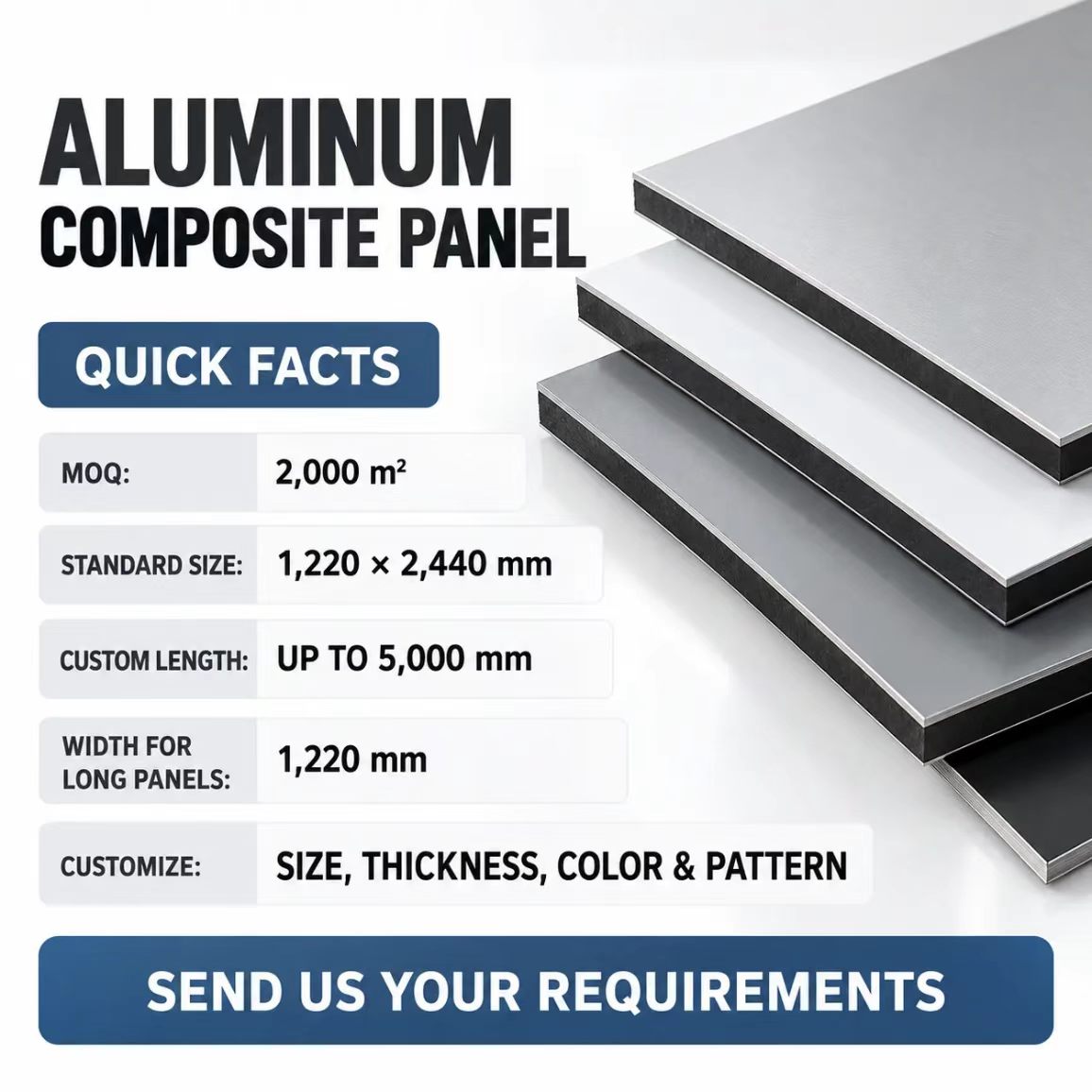
For a 4mm Alucobond 4x10 sheet in PVDF, confirm 0.5 mm aluminum skins on both faces. Thin skins dent during installation and lose flatness on a hot wall. Alucobond’s standard architectural spec uses 0.5 mm skins with an AlMg1 alloy for corrosion resistance.
5. Warranty terms that match the climate.
A meaningful PVDF warranty covers color change (ΔE ≤5), chalking (rating ≤8), and gloss retention (≥50%) for at least 10 years, and preferably 15–20 years. A short or vague warranty signals a lower-grade coating.
6. Edge sealing and fabrication instructions.
Cut edges and routed folds expose the core. Unsealed edges wick moisture into the panel and cause delamination—the structural failure mode that outruns coating fade. The supplier should provide written fabrication and edge-sealing procedures with the order.
When PE Is Still the Right Call
PE is not a bad product. It is a product for the wrong wall.
Specify PE when:
- The panels go indoors.
- The project is temporary—signage, hoarding, or a short-term enclosure expected to last under five years.
- The wall is fully sheltered from direct sun and rain.
For any permanent exterior cladding in a high-UV tropical climate, PVDF is the specification that protects the building owner’s investment and the contractor’s reputation.
Final Recommendation for Tropical Procurement
Specify 70% PVDF, AAMA 2605, on 4mm ACP with 0.5 mm skins for all exterior cladding in high-UV tropical zones. The coating premium is small next to the cost of premature replacement. The performance gap is not incremental—PVDF outlasts PE by two to three times in exactly the conditions that define tropical exposure.
When you request quotes, send the resin percentage, AAMA standard, film thickness, and warranty terms as mandatory submittals. A supplier who can meet those requirements in writing is selling real PVDF. A supplier who hedges is selling a coating that will chalk before the building’s first repaint cycle.