Welcome to Vbond
The 8-12mm Joint Rule: Optimal Gap Width for Blister-Free Alucobond Installation
You stand back and admire the finished facade. The panels line up perfectly. The joints are tight. The finish is flawless.
Then summer arrives. The sun hits the building. You see them. Raised bumps spread across the panel surface. The sleek facade now looks damaged.
What happened? Thermal expansion. The panels moved. And the joints were too small.
This guide explains the 8- 12 mm joint rule. You will learn why this gap width prevents blistering. You will understand the physics behind the number. And you will know exactly how to size your joints for a blister-free Alucobond installation.
The Physics: Why Alucobond Panels Move
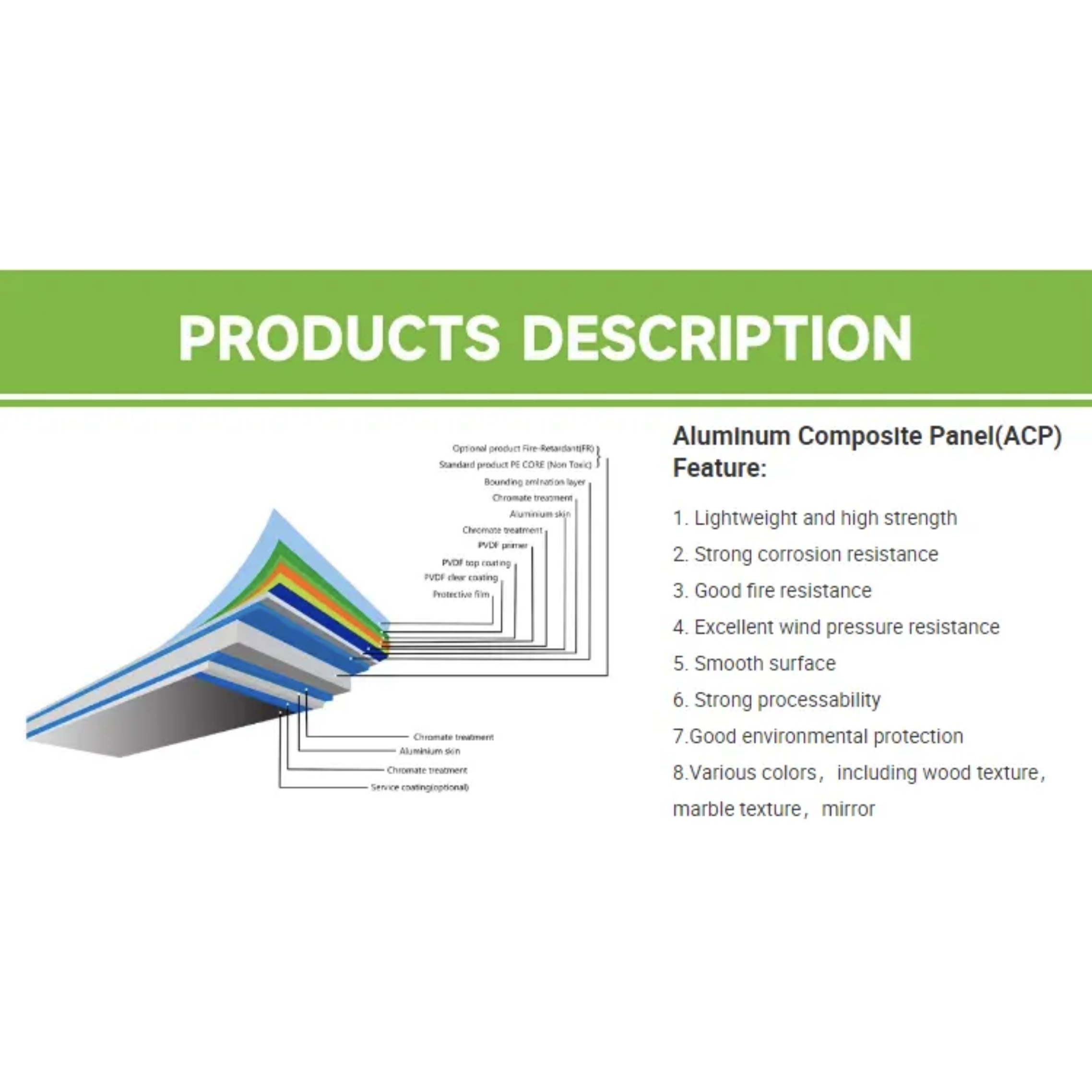
Alucobond is a composite panel. Two aluminum skins bond to a core. Aluminum expands when heated. It contracts when cooled.
The linear thermal expansion of an Alucobond panel is 2.4 mm per meter of panel length for every 100°C temperature difference**.
In plain English:
A 1-meter-long panel expands by 2.4 mm when its temperature rises by 100°C. A 3-meter panel expands by 3.6 mm. A 4-meter panel expands by 4.8 mm.
The calculation formula
Expansion (mm) = 2.4 × L (meters) × (ΔT ÷ 100)
Where ΔT is the temperature difference between the installation temperature and the maximum expected panel temperature.
The 3-Meter Panel Example
Take a typical 3-meter Alucobond panel:
- Expected panel heating: 70°C max (measured on a dark panel at 40°C air temperature)
- Assumed installation temperature: 20°C
- Temperature difference: **50 K**
Calculation:
2.4 mm × 3 (meters) × 0.5 (50 K ÷ 100) = **3.6 mm total expansion
Half of that expansion (1.8 mm) must be expected on each opposite panel edge. Each panel edge needs at least 1.8 mm of clearance.
That is the absolute minimum. Real-world conditions require more margin.
The 8- 12 mm Rule: Where It Comes From
Industry practice and technical guidelines recommend 8-10 mm joints as a general rule.
Why 8mm minimum?
A 3.6 mm expansion needs at least 1.8 mm per edge. Add 2-3 mm of safety margin for installation tolerances, building movement, and measurement errors. You get approximately 5-6 mm total. But 8 mm provides an additional safety buffer for:
- Dark-colored panels that absorb more heat
- High-altitude locations with greater UV exposure
- Buildings in extreme climates
- Installation tolerances
- Wind-induced panel movement
Why 12mm maximum?
Joints wider than 12 mm create challenges:
- Sealant must span a wider gap, requiring higher displacement capacity
- Backer rods must be larger
- Visual appearance becomes less crisp
- Water management becomes more difficult
For most applications, 8-12 mm is the optimal range. For runs exceeding 6 meters or large-format panels, 12-15 mm may be required.
Where the industry stands:
Source | Recommended Joint Width |
ALUCOBOND processing manual (general rule) | 8–10 mm |
ACP installation best practices | 5–10 mm between panels |
Exterior cladding specifications | 12–15 mm minimum |
Chinese installation standard | 10 mm minimum |
Caption: Industry recommendations for Alucobond expansion joint width. Source: ALUCOBOND technical data and industry standards.
Alt text: Table showing recommended joint widths from various industry sources, including ALUCOBOND processing manual, ACP installation best practices, and Chinese installation standards.
Why Correct Joint Width Prevents Blistering
Blistering happens when the adhesive bond between the aluminum skin and the core fails. Thermal stress is the primary cause.
The mechanism with too-small joints:
1. The sun heats the panel. The panel expands. The core expands even faster.
2. The panel has no room to move. The fasteners prevent outward expansion.
3. Stress builds inside the panel. The adhesive bond is overloaded.
4. The bond fails. Voids form between the aluminum skin and the core.
5. Those voids become visible blisters.
The mechanism with the correct 8- 12 mm joints:
1. The sun heats the panel. The panel expands. The joint gap closes.
2. The expansion force dissipates into the open gap.
3. Stress does not build up. The adhesive bond is not overloaded.
4. No bond failure. No voids. No blisters.
The Jointing section of the ALUCOBOND processing manual emphasizes this principle: "To avoid any tension occurring in the rivet and screw connections, the rivets and screws must be set tension-free. The bore holes in the panels must be large enough to allow for the expected thermal expansion".
Joint Width by Panel Size and Climate
10 mm minimum | Climate | Recommended Joint Width |
Up to 2 meters | Moderate | 6–8 mm |
2–4 meters | Moderate | 8–10 mm |
2–4 meters | Extreme (dark color, high sun) | 10–12 mm |
4–6 meters | Moderate | 10–12 mm |
Over 6 meters | Any | 12–15 mm (expansion joint required) |
Caption: Recommended joint widths for Alucobond panels by length and climate. Source: Industry practice and ALUCOBOND technical data.
Alt text: Table showing recommended joint widths for different panel lengths and climate conditions.
Fastener Holes: The Hidden Gap
Expansion gaps between panels are not enough. The fastener holes must also allow for movement.
The rule from ALUCOBOND technical guidelines:
"To avoid jamming, the hole in the panel must be large enough to allow for expansion". "With the shaft of the rivet fitting closely to the edge of the hole, the attachment head must cover 1 mm of the area surrounding the hole".
Component | Requirement |
Hole in the panel | Larger than the fastener shaft |
Attachment head | Covers at least **1 mm** beyond the hole edge |
Rivet shaft | Fits closely to the hole edge |
Drilling method | Centrally drilled using drilling jigs |
Caption: Fastener hole requirements for Alucobond expansion joints. Source: ALUCOBOND processing guidelines.
Alt text: Table showing hole size requirements including panel hole size, attachment head coverage, rivet shaft fit, and drilling method.
Rivet attachment jigs are used for fitting blind rivets without jamming, allowing for a tolerance of 0.3 mm.
Expansion Joints for Long Runs
For panel runs exceeding 6 meters, physical expansion joints are required. The panels cannot expand continuously across a long facade. The cumulative movement becomes too large.
The rule: Insert expansion joints every 6 meters of continuous panel run. The joint width should be calculated using the same formula, with a minimum of 10-12 mm.
The Complete Installation Flowchart
Start
│
▼
Determine panel length and climate conditions
│
▼
Calculate expected expansion: 2.4 × L × (ΔT ÷ 100)
│
▼
Select joint width (8- 12 mm minimum for standard panels)
│
├─── Panel runs> 6 m ───► Add expansion joints (10- 12 mm minimum)
│
▼
Size fastener holes (larger than shaft, 1mm head coverage)
│
▼
Design one fixed point per panel (central)
│
▼
Design all other attachments as sliding points
│
▼
Install with rivet attachment jigs (0.3mm tolerance)
│
▼
Do not over-tighten fasteners
│
▼
Inspect joint width and fastener movement
│
▼
Done ───► Blister-free Alucobond installation
Common Mistakes to Avoid
Mistake 1: Using joints that are too small
The most common mistake. Installers want tight, clean joints. The panels cannot expand. They buckle or blister.
Fix: Use 8- 12 mm joints minimum. Calculate the expected expansion for your project.
Mistake 2: Forgetting the fastener holes
Even with correct panel gaps, tight fastener holes prevent movement. The panel cannot slide. Stress builds. Buckling follows.
Fix: Size fastener holes to allow for expansion. The attachment head must cover at least 1 mm beyond the hole edge.
Mistake 3: Not accounting for dark colors
Dark-colored panels absorb more heat. They expand more. A black panel on a sunny facade can reach 70°C or higher.
Fix: Use the maximum expected panel temperature for your color and climate.
Mistake 4: Installing on hot days
Panels installed at high temperatures will contract in winter. The gaps will open. Panels installed at low temperatures will expand in summer. They may buckle.
Fix: Consider the installation temperature in your calculation. Allow for both expansion and contraction.
What to Ask Your Supplier
When you purchase an Alucobond panel for your project, ask these questions:
1. What is the thermal expansion coefficient? The answer should be 2.4 mm/m/100°C.
2. What expansion gap do you recommend for my panel size and climate? A knowledgeable supplier will provide specific calculations.
3. What fastener hole size do you recommend? The hole must allow for expansion—the attachment head must cover at least 1 mm beyond the hole.
4. Do you provide joint design guidelines? A reliable manufacturer will have technical documentation.
The Bottom Line
The 8- 12 mm joint rule is not arbitrary. It is based on the physics of thermal expansion. An Alucobond panel expands at 2.4 mm per meter for every 100°C temperature change. A 3-meter panel in a 50°C swing moves 3.6 mm. Without room to move, that force buckles, warps, and blisters the panel.
Joints smaller than 8 mm trap thermal stress. The adhesive bond fails. Blisters form.
Joints larger than 12 mm create sealant and water management challenges. The sweet spot is 8-12 mm.
The design is straightforward:
- Calculate the expected expansion
- Use 8- 12 mm joints for standard panels
- Use 10- 12 mm joints for long runs or extreme climates
- Size fastener holes to allow movement (1 mm head coverage minimum)
- Add expansion joints for runs exceeding 6 meters
A reliable Alucobond panel supplier provides the technical data. Your joint design determines the quality. Get the gaps right, and your facade stays flat for decades. Get them wrong, and the blisters appear within months.