Welcome to Vbond
Wind Pressure + Poor Framing = Bubble Formation: The Alucobond Physics Explained
You stand back and admire the new facade. The panels line up perfectly. The finish is flawless.
Six months later, you see them. Bubbles. Raised bumps across the panel surface. The client demands answers. The manufacturer blames the installation. The installer blames the material.
The real culprit is physics. Specifically, the combination of wind pressure and poor framing.
This guide explains the physics behind Alucobond bubble formation. You will learn how wind pressure loads the panel. You will understand why poor framing makes it worse. And you will know exactly how to prevent bubble formation.
How Wind Pressure Acts on Alucobond Panels
Wind does not push evenly on a building. It pushes harder on some areas than others. Corner zones experience suction forces two to three times higher than the center of the wall. Parapet edges take the worst of it.
Wind exerts two distinct forces on a facade panel:
- Positive pressure pushes the panel inward.
- Negative pressure (suction) pulls the panel outward.
Negative pressure often governs the design. It can be significantly higher than positive pressure on the same surface. For a typical high-rise facade, design wind loads reach 2.0 to 5.0 kPa.
What this means for Alucobond:
A 4mm Alucobond panel has a stiffness value (E·J) of 2400 kNcm²/m. That is high for its weight—Alucobond weighs only 5.4 kg/m². But the panel is still a thin shell. It flexes under load.
When wind pressure bends a panel too far, the aluminum skins can crack, or the core can separate from the aluminum—a failure known as delamination.
How Poor Framing Makes It Worse
The substructure behind the panel determines how much the panel can flex. Poor framing means insufficient support. Insufficient support means more deflection. More deflection means more stress on the adhesive bond.
What poor framing looks like:
- Supports spaced too far apart
- Framing that deflects under load
- Missing or undersized stiffening ribs
- Uneven subframe alignment
- Inadequate connection between panel and frame
The physics:
When wind hits the panel, the panel transfers the load to its connections. The pulling forces on screws from negative wind pressure can be substantial. If the framing deflects, the panel deflects more. If the panel deflects more, the adhesive bond between the aluminum skin and core is stressed beyond its limit.
What the standards say:
Chinese technical standard JGJ 255-2012 specifies that when metal panels are subjected to wind or seismic loads, the "middle ribs should have sufficient stiffness, and their deflection should not exceed 1/300 of the rib span".
The standard also mandates that "for aluminum-plastic composite panels, edge ribs should be set at the folded edges". Panels without edge ribs and middle ribs deform under wind pressure and air expansion.
The Physics of Bubble Formation
Here is the sequence of events that creates bubbles.
Step 1: Wind loads the panel.
Wind pressure bends the panel inward or pulls it outward. The panel flexes. The flexing creates tension in the aluminum skins and stress in the adhesive bond.
Step 2: The panel deflects beyond its elastic limit.
Because the framing is inadequate, the panel deflects too far. The aluminum skins stretch. The core compresses. The adhesive bond is overloaded.
Step 3: The adhesive bond fails.
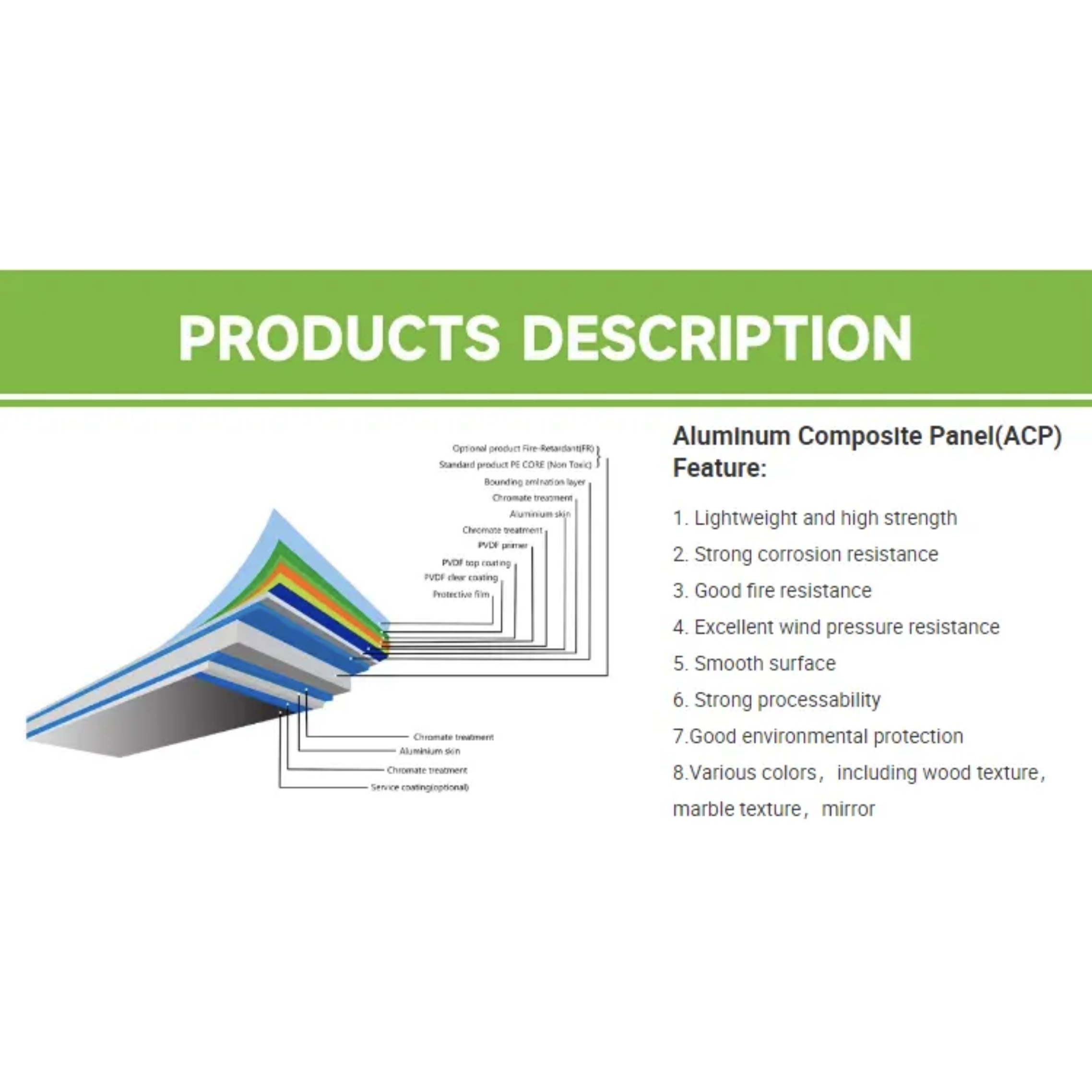
An Alucobond panel is a sandwich: two thin aluminum skins bonded to a core. The bond between the skin and core determines whether the panel behaves as a single, stable unit. When bonding strength is inadequate, delamination occurs.
Strong bonding ensures that the panel resists thermal expansion forces, wind pressure, and humidity. Weak bonding fails under the same forces.
Step 4: A void forms.
The aluminum skin separates from the core. A void forms between the layers. That void is a bubble.
Step 5: The bubble grows.
Air, gas, or moisture vapor fills the void. Pressure builds. The bubble expands. The panel surface bulges.
The severity of a blister depends on three factors:
- Bond strength – How well the adhesive initially adhered the aluminum to the core
- Vapor pressure – The force of expanding gas or steam within the void
- Core integrity – Whether the core material itself is degrading
The Bubble Formation Flowchart
Start
│
▼
Wind pressure hits the panel
│
▼
Panel transfers load to framing
│
├─── Framing is adequate ───► Panel deflects within limits ───► No bubbles
│
└─── Framing is inadequate ───► Panel deflects too far
│
▼
Adhesive bond between skin and core is stressed
│
▼
Bond fails
│
▼
Void forms between aluminum skin and core
│
▼
Air, gas, or moisture vapor fills the void
│
▼
Pressure builds
│
▼
Bubble appears on panel surface
│
▼
Facade appearance is compromised
The Numbers: How Much Deflection Is Too Much?
Component | Maximum Deflection | Standard |
Perimeter framing members | L/175 | Industry standard |
Panel stiffeners (ribs) | L/300 | JGJ 255-2012 |
Individual panels | L/60 | Industry standard |
Caption: Maximum allowable deflection limits for Alucobond curtain wall components.
Alt text: Table showing maximum deflection limits for perimeter framing members (L/175), panel stiffeners (L/300), and individual panels (L/60).
These numbers matter. A framing system that deflects beyond these limits will cause panel distortion, fastener stress, and potential system failure.
How to Prevent Wind-Induced Bubbles
1. Design the substructure correctly.
The substructure must have sufficient stiffness. Supports must be spaced correctly. Stiffening ribs must be added where needed.
What the standards require:
- Edge ribs at all folded edges
- Middle ribs with sufficient stiffness
- Rib deflection not exceeding L/300
- Rib section thickness not less than 1.5mm
2. Use proper fastening systems.
The connection between the frame and the panel must meet the requirements for reliable force transmission. Do not rely on adhesive alone.
3. Choose panels with adequate bonding strength.
Industry-accepted minimum thresholds for exterior-grade ACPs start at 4 N/mm peel resistance, as measured by ASTM D1781. Premium panels for high-rise or high-wind applications achieve significantly higher values.
If a supplier cannot provide ASTM D1781 test results, do not buy from them.
4. Work with a quality supplier.
A reliable Alucobond supplier for exterior walls will provide panels with consistent bonding strength. A reputable manufacturer of Alucobond will have quality control documentation.
5. Inspect the framing before installation.
Check that the subframe is straight, stable, properly aligned, and free from unnecessary movement. Even a small misalignment can become visible once smooth panels are installed across a large elevation.
The Prevention Flowchart
Start
│
▼
Design substructure with adequate stiffness
│
├─── Edge ribs at all folded edges
├─── Middle ribs for large panels
└─── Rib deflection ≤ L/300
│
▼
Select panels with bonding strength ≥4 N/mm (ASTM D1781)
│
▼
Use proper fastening systems
│
▼
Inspect framing before installation
│
▼
Install panels with proper alignment
│
▼
Done
What to Ask Your Alucobond Supplier for Exterior Walls
When you work with an Alucobond supplier for exterior walls, ask these questions:
1. What is your panel's bonding strength (peel resistance) in N/mm? The answer should be ≥4 N/mm** and backed by ASTM D1781 test results.
2. What substructure spacing do you recommend? A knowledgeable manufacturer of Alucobond will provide support spacing guidelines.
3. Do you require edge ribs and middle ribs? The answer should be yes for exterior applications.
4. What fastening systems do you recommend? A reliable wholesale supplier of Alucobond will have documented fixing guidelines.
5. Can you provide wind load calculation documentation? A distributor of Alucobond panels should be able to supply technical data.
The Bottom Line
Wind pressure and poor framing create bubbles. The physics is simple: wind loads the panel. Poor framing allows excessive deflection. Excessive deflection stresses the adhesive bond. The bond fails. A void forms. A bubble appears.
Prevention is straightforward:
- Design the substructure with adequate stiffness
- Meet deflection limits: L/175 for framing, L/300 for ribs
- Use panels with bonding strength ≥4 N/mm
- Include edge ribs and middle ribs
- Use proper fastening systems
A reliable alucobond supplier for exterior wall provides panels with documented bonding strength. Your substructure design provides the support. Together, they prevent bubble formation.
Your facade will stay flat. Your client will stay happy. Your reputation will stay intact.